

We Got Hit by the March 2026 Spam Update. Here’s the Data on What Recovery Actually Took.
Hit by Google's March 2026 spam update, we lost ~97% of impressions overnight. The indexed data on what a 14-week recovery actually took.

On March 25, 2026, Google’s March spam update erased roughly 97% of our search impressions in a single day. Fourteen weeks later, our impressions are pacing at roughly twice the pre-collapse rate, with 51 keywords in the top 10. What fixed it was not content. Recovery came after we removed 94 links we had placed ourselves across a network of sites we own, pruned half our blog, and earned our first editorial links from real publications. Ten weeks of on-page remediation before that changed nothing.
This is the full dataset, indexed so you can use the shape without our raw numbers.
TL;DR
- The hit: March 2026 spam update (March 24-25, a 19.5-hour rollout). Our impressions fell ~97% in one step and flatlined for 14 weeks. No manual action, no notice in Search Console. Pure algorithmic devaluation.
- What did nothing: 10 weeks of on-page work. 88 blog posts rewritten, every commercial page rebuilt, external spam disavowed. Zero movement.
- What preceded recovery: removing 94 self-placed network links (June 17), pruning the blog from 94 to 45 posts (June 24), and five editorial links from DR 74-88 publications (June 18 to July 7).
- The trigger window: the June 2026 spam update (June 24-26), which Google confirmed did NOT target link spam. Our recovery began June 29, twelve days after the cleanup.
- The result so far: impressions up 11x month over month, average position from ~35 to ~16, 51 keywords in the top 10, Ahrefs DR from 22 to 29.
- The catch: the old link value never came back, and never will. Google is explicit that devalued link benefit “cannot be regained.” What recovered is a new site, on new authority.
Why you can trust this data (and why we’re publishing it)
We sell links. Hetneo operates homepage link placements, guest posts, and PBN links, built on a network of more than 100 aged Canadian domains we own outright. We are exactly the kind of site spam updates are designed to catch, and in March 2026, one caught us.
Most spam update post-mortems are written by agencies analyzing other people’s sites from the outside. This one is written from inside the blast radius, with our own Search Console, Ahrefs, and server data. We think that first-hand view is worth more than our comfort.
One methodology note. We do not publish absolute traffic numbers, so every traffic and impression figure below is indexed to our pre-collapse March 2026 baseline (March = 100) or expressed as a multiple. Positions, keyword counts, and Ahrefs DR are shown as-is, since they reveal nothing about scale.
What does a spam update suppression look like in the data?
It looks like a cliff, not a slope. Google announced the March 2026 spam update on March 24 at 3:20 p.m. ET, and it finished rolling out 19 hours and 30 minutes later, unusually fast for a spam update. Our impressions collapsed within that window, in a single step we can now match to the hour.
Here is the monthly shape, indexed to March = 100:
| Month (2026) | Impressions (indexed, March = 100) | Average position |
|---|---|---|
| February | 46 | 34.9 |
| March (update on Mar 24-25) | 100 | 28.2 |
| April | 2.4 | 8.1* |
| May | 2.4 | 10.7* |
| June (recovery began Jun 29) | 26 | 17.6 |
| July (first 5 days, daily pace) | ~195 | 15.4 |
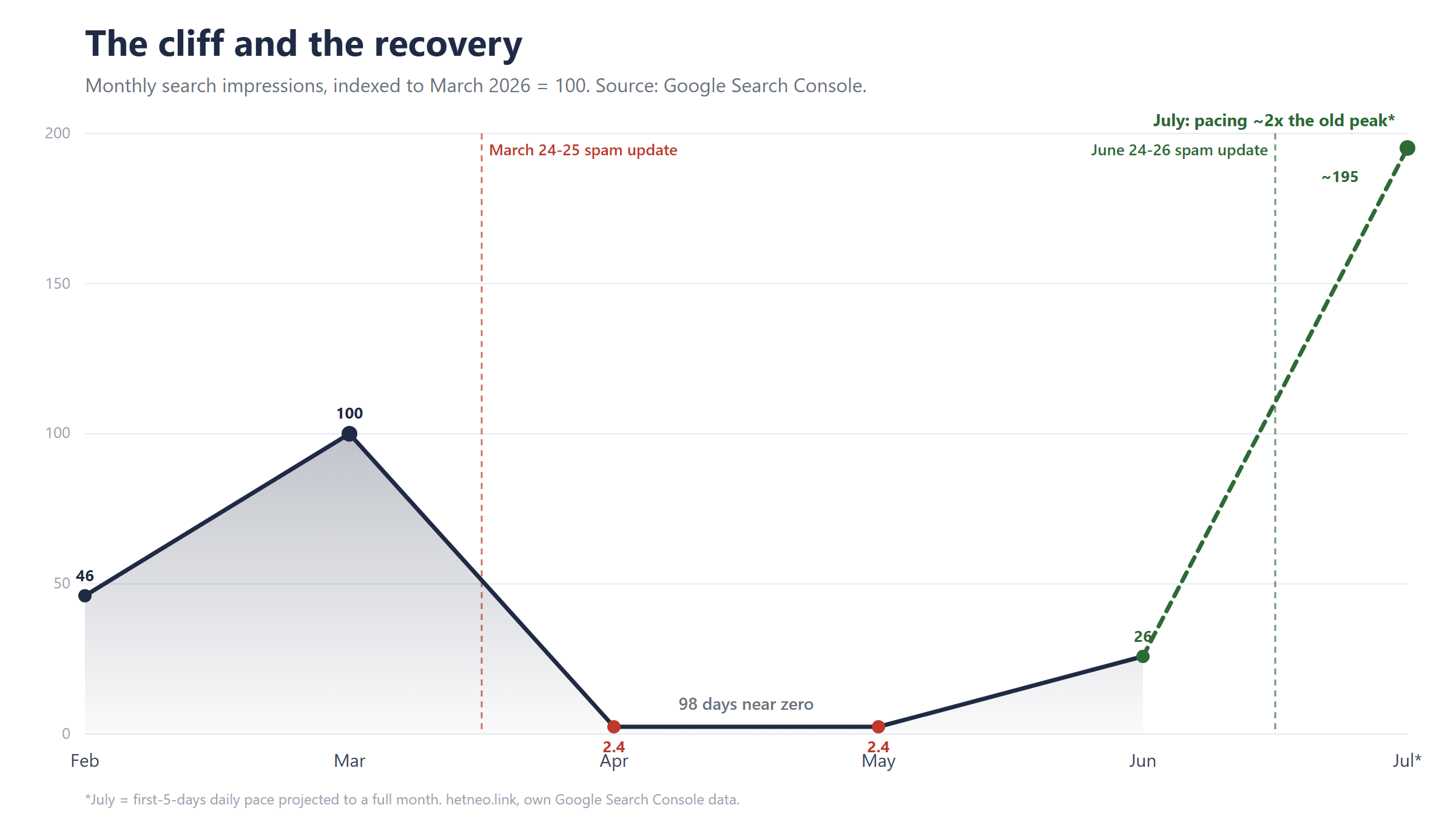
*The April and May “improvement” in average position is an artifact, and it is worth understanding. When a suppression wipes out your non-brand queries, only brand searches remain, and brand always ranks well. Our CTR also spiked above 11% in those months for the same reason: the only people still finding us were looking for us by name.
Three properties of the suppression told us what we were dealing with:
- It was sitewide. Every page lost every non-brand query at once. Individual pages do not all fail simultaneously; classifiers reclassify sites.
- It was binary. Ahrefs’ estimated organic traffic sat at exactly zero for 98 consecutive days (March 23 to June 28). Not reduced. Zero.
- It was silent. No manual action, nothing in Search Console. Spam updates work by devaluation, not penalty notices.
Why did the update hit us?
Because our authority was manufactured, and the pattern was textbook. Our link profile was ~100 self-owned aged domains, each placing a homepage link back to our own site. Google’s spam policies name this pattern almost verbatim: “widely distributed links in the footers or templates of various sites” is listed as link spam.
We ran the numbers on our own network after the hit, and the honest audit was humbling. Of 117 link placements across the network, only 16 sites genuinely ranked for anything. Roughly 80 had zero organic traffic at all, despite an average DR around 30.
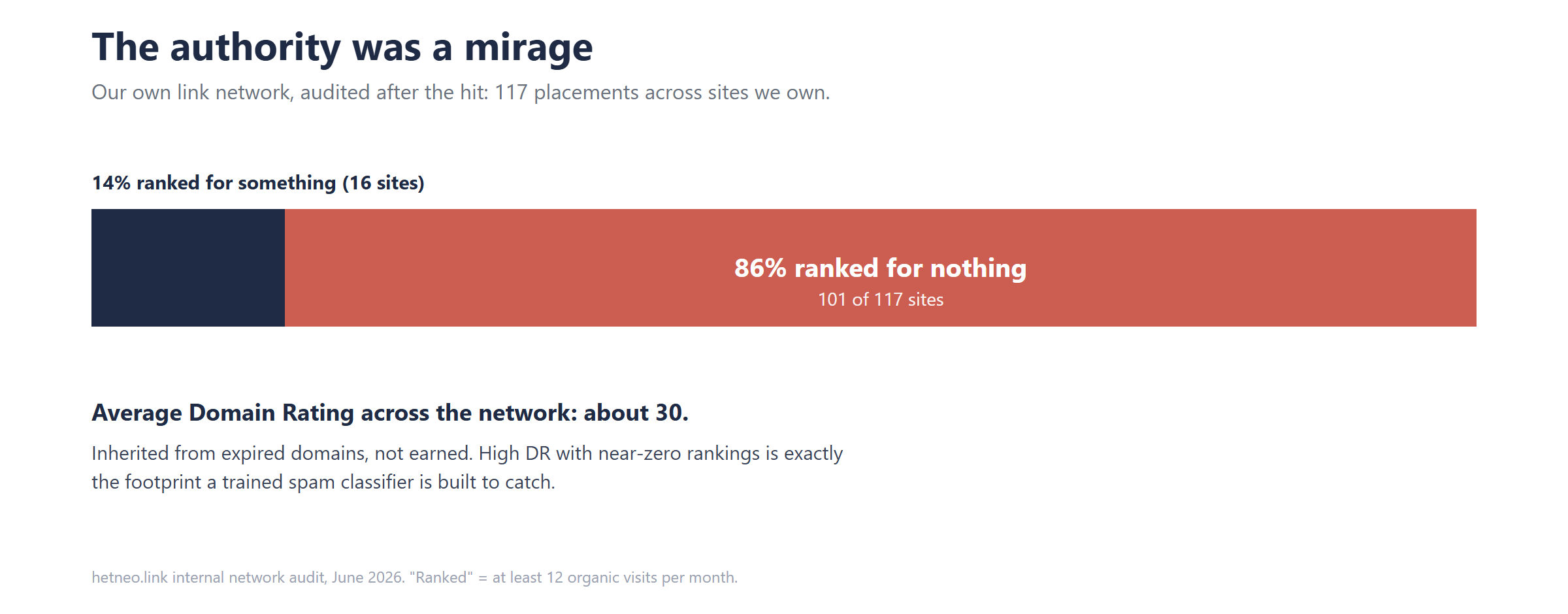
That gap is the fingerprint. High legacy authority inherited from expired domains, templated sites of roughly 25 pages each, clustered hosting, and near-zero real rankings is exactly what a trained classifier looks for. Google has said since 2022 that SpamBrain detects “both sites buying links, and sites used for the purpose of passing outgoing links.” We were both halves of that sentence at once.
The mechanism matters for what comes next: the update did not penalize us in the classic sense. It devalued the links, the manufactured authority evaporated, and with no earned authority underneath, non-brand visibility went to zero.
Does on-page remediation fix a link-based suppression?
No. We proved this the expensive way, with ten weeks of disciplined work that moved nothing.
Between April and mid-June we rewrote and enriched 88 blog posts, rebuilt every commercial page, cleaned every technical issue our audits could find, and disavowed the external spam domains piling onto our profile. The site passed every on-page audit from mid-May onward. Impressions stayed at 2% of baseline the entire time.
This is the first finding we want other operators to take seriously. If your suppression is a link-graph classification, content quality is the floor, not the lever. You cannot write your way out of a link problem, and every week spent trying is a week the actual constraint goes unaddressed.
You cannot write your way out of a link problem.
The on-page work was not wasted; it is the foundation the recovery now stands on. But as a recovery lever, it tested at zero.
What actually moved the needle?
Three things, all within a ten-day window in mid-June.
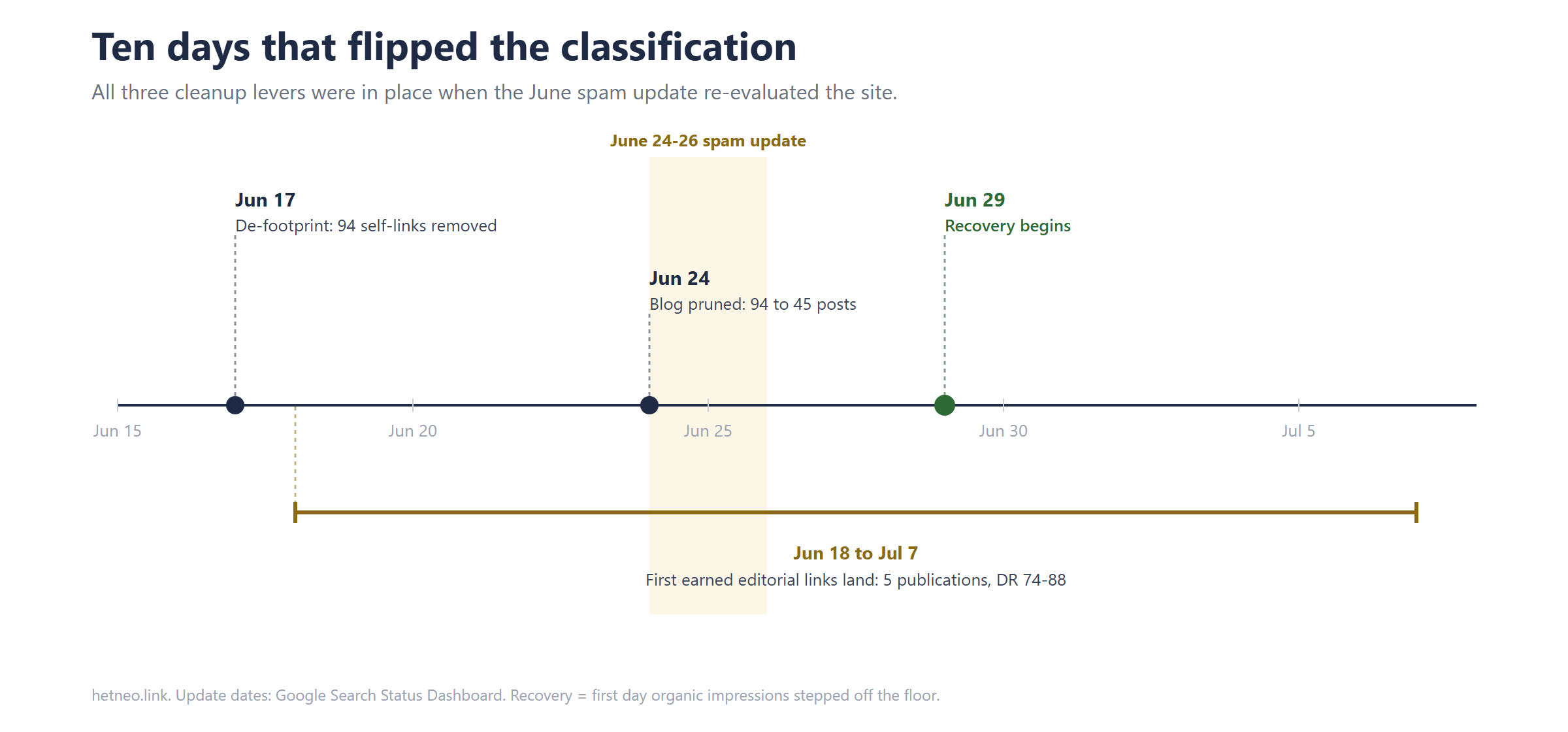
1. The de-footprint (June 17). We removed 94 of our own network links pointing at our site, unpublishing the placements across the network. We triaged first: since only 16 of 117 network sites genuinely ranked, the links we removed were already carrying no value. The update had neutralized them months earlier, so removal cost us nothing and deleted the footprint.
Note what we did not do: we did not disavow our own network. Disavow is for links you cannot control. When you own the sites, removal is cleaner and stronger.
2. Content pruning (June 24). We cut the blog from 94 published posts to 45, unpublishing everything that had earned no impressions and no links. Thin, unvisited content is dead weight in a spam evaluation, and we removed it in bulk.
3. The first earned editorial links (June 18 to July 7). Five placements landed on real publications in the DR 74-88 range, earned through outreach, guest contributions, and digital PR rather than placed on sites we own. This was the first cohort of a deliberate strategy: replace manufactured authority with authority someone else has to agree to give you. Our guest post work now runs exclusively on this editorial model.
Then the window opened. The June 2026 spam update rolled out June 24-26. Google confirmed to Search Engine Roundtable that it did not target link spam. It did not need to. Our cleaned-up profile was simply in place when Google’s spam systems re-evaluated the site, and on June 29, twelve days after the de-footprint, the suppression lifted in a step as sharp as the one that started it.
Can you recover from a link spam devaluation?
Yes, and here is the recovery in one table. But read the mechanism carefully, because “recovery” is the wrong mental model.
| Metric | Suppression (April-May) | Post-recovery (Jun 29 – Jul 7) |
|---|---|---|
| Impressions (indexed, March = 100) | 2.4 | June: 26; early-July daily pace: ~195 |
| Month-over-month impressions | flat | 11x (June vs May) |
| Average position | brand-only artifact | ~16 (vs ~35 in February) |
| Keywords in Google top 10 | ~0 non-brand | 51 |
| Keywords in positions 11-20 | ~0 non-brand | 54 |
| Ahrefs estimated organic traffic | 0 for 98 straight days | stepped off zero Jun 29, climbing weekly |
| Ahrefs DR | 22 | 29 |
The commercial terms came back too. “Buy pbn links” sits at position 8.9, “cheap pbn links” at 4.6, and our PBN links page re-entered the US top 10 for “pbn links” at #9 (#6 in Canada), our first top-10 commercial keyword since the collapse. Positions arrived before clicks, which is normal for a days-old recovery in ad-heavy commercial SERPs; click-through is our next battle, not visibility.
Now the mechanism. Google’s documentation is unambiguous about link devaluations: “any ranking benefit the links may have previously generated for your site is lost. Any potential ranking benefits generated by those links cannot be regained.”
Our data agrees with Google. The site that recovered is not the old site restored. It ranks on 5 editorial referring domains and 45 focused pages, not on 100 network links and 94 posts. The old boost is gone forever; what lifted is new, earned authority being evaluated without a spam classification sitting on top of it. If you are waiting for your pre-update rankings to simply return after a cleanup, you are waiting for something Google has explicitly said will not happen.
| The site that collapsed | The site that recovered | |
|---|---|---|
| Authority source | About 100 self-owned network links | 5 earned editorial links, DR 74-88 |
| Who placed them | We did, on sites we own | Real editors, on sites we do not |
| Content footprint | 94 posts, half of them unread | 45 focused posts |
| Under a spam update | Reclassified as spam | Evaluated cleanly |
| Durability | Neutralized, gone for good | Compounds, survives updates |
Which of the three levers caused the recovery?
We cannot cleanly separate them, and we will not pretend otherwise. The de-footprint, the pruning, and the first editorial links all landed within ten days of the June update. Any of the three, or the combination, could have flipped the classification.
What we can say with confidence:
- It was not on-page quality. The site was clean from mid-May with zero movement. Ten weeks of controlled nothing is a strong null result.
- It was not the June update “forgiving” link spam. Google confirmed the update did not target link spam, so the lift is not the link system re-running in our favor. The likelier mechanism is that spam updates refresh classifications broadly, and sites that cleaned up after earlier updates are re-read during them. Google also told Search Engine Roundtable it runs periodic refreshes of spam systems and that recovery “can take many months.”
- It was not the negative SEO cleanup. A pile of external spam domains kept accumulating against us through the entire recovery and did not prevent it.
Operationally, the ambiguity does not matter. All three levers are the strategy. We would pull all three again, in the same order, and we are keeping all three pulled.
The de-footprint checklist
If your non-brand traffic went to zero around a spam update and your link profile contains links you placed yourself, this is the playbook our data supports.
- Inventory every link you control. Own it internally before Google explains it to you. Networks, footer placements, template links, reciprocal schemes, widgets.
- Triage by real value, not DR. Check whether each linking site actually ranks for anything. In our network, 86% of sites did not. High-DR domains with zero rankings are footprint, not authority.
- Remove what you control; disavow only what you cannot. Unpublish self-placed links at the source. Reserve the disavow file for external spam you have no access to.
- Kill the template pattern first. Homepage, footer, and sitewide placements are the exact pattern Google’s spam policies name. They go first.
- Prune content that earns nothing. Posts with no impressions, no clicks, and no links subtract from a sitewide quality evaluation. We cut 52% of ours.
- Start earning editorial links immediately. Removal alone leaves a vacuum. Give the re-evaluation a new profile to read: real publications, real editors, sites you do not own.
- Treat spam updates as re-evaluation windows. Your cleanup must be live before the next update runs, because that is when classifications get refreshed. Two spam updates shipped in the first half of 2026 alone.
- Expect months, then be surprised. Google says recovery from spam issues takes months as systems re-learn trust. Our gap from cleanup to lift was twelve days, but only because an update happened to run twelve days after we finished. Plan for the months; treat the twelve days as luck of the calendar.
- Never re-light the old links. A recovery is a reclassification, and reclassification runs both ways. The footprint that got you hit will get you hit again, faster.
FAQ
How long does it take to recover from a Google spam update?
Google says months, and plans for periodic refreshes of its spam systems. Our timeline was 14 weeks from collapse to recovery, but only 12 days from completing the link cleanup to the lift, because the June 2026 spam update ran right after our cleanup was in place. The lesson: the clock starts when your cleanup is done, and the lift lands at a re-evaluation, which you cannot schedule.
Do rankings return to their old levels after a link devaluation?
No, and Google says so explicitly: ranking benefit from devalued links “cannot be regained.” Recovery is new authority being evaluated cleanly, not old authority coming back. Our post-recovery visibility now paces above the old baseline, but it is built on different links, different content, and different queries.
Should you disavow links from sites you own or control?
No. Remove them at the source; that is stronger, cleaner, and does not depend on Google processing a disavow file. Use the disavow tool only for external spam you cannot take down, like negative SEO domains.
Did the June 2026 spam update target link spam?
No. Google confirmed the June 2026 update did not target link spam or site reputation abuse. Sites with link problems still recovered during it (we are one), which is consistent with spam updates refreshing older classifications broadly rather than only enforcing the named target.
Was there a manual action or penalty notice?
No. Nothing appeared in Search Console at any point. Algorithmic spam devaluations are silent: links stop passing value, rankings collapse, and no one tells you why. If your profile matches the pattern and the date matches an update, treat it as a classification even without a notice.
Would the recovery have happened without removing the links?
Our data cannot answer that, because we pulled the removal, pruning, and link-earning levers together. What we can say is that ten weeks of everything except link work produced zero movement, and twelve days after the link work was in place, the suppression lifted. We were not willing to leave a documented footprint live to find out, and with Google shipping two spam updates in six months, we would not advise you to either.
What we’d tell you if you’re where we were in April
The worst weeks were the ones spent fixing the wrong constraint. If your collapse was sitewide, non-brand, and step-shaped on an update date, audit your link profile with the honesty of someone who expects to be embarrassed by it. Ours failed that audit, we removed what we had built, and the recovery came from links no network can manufacture.
That experience now shapes what we sell. We still operate PBN links for buyers who understand exactly what they are and what they cost when they go wrong; this article is the longest possible answer to that question. And we build editorial guest post placements and earned link campaigns for the Canadian and US markets on the model that actually survived a spam update: real publications, real editors, links someone else agreed to give. If you are staring at your own cliff and want a second pair of eyes on the data, we have been there, recently enough that the dashboards are still open.
Sources
- Google Search Status Dashboard, ranking updates history: status.search.google.com
- Search Engine Land, “Google March 2026 spam update done rolling out” (March 24-25, 2026; 19h30m rollout): searchengineland.com
- Search Engine Roundtable, “Google June 2026 Spam Update Is Done Rolling Out” (June 24-26, 2026; does not target link spam; periodic refreshes): seroundtable.com
- Google Search Central, spam policies (link spam definitions): developers.google.com
- Google Search Central, spam updates documentation (“cannot be regained”): developers.google.com
- Google Search Central Blog, “December 2022 link spam update releasing for Google Search”: developers.google.com
Data sources for this article: our own Google Search Console property, Ahrefs, and internal server logs, pulled July 7, 2026. Traffic and impression figures are indexed to our March 2026 pre-collapse baseline (March = 100) or expressed as multiples; positions, keyword counts, and DR values are unmodified.

