

This SEO Recovery Method Rescued Sites Hit by Google’s Core Updates

Google core update recovery isn’t speculation—it’s documented, repeatable work. This collection curates proven case studies where sites regained 40–300% of lost organic traffic after algorithmic penalties, alongside forensic breakdowns of failed attempts. You’ll find timelines showing recovery velocity (typically 3–9 months), tactical checklists for content pruning and E-E-A-T signals, and clear qualifiers that determine whether your site profile matches recovery candidates. No theoretical frameworks or SEO folklore—just signal-dense links to audits, before/after metrics, and tactical playbooks from publishers and agencies who logged the work.
What the Case Study Tested
The experiment tracked three affiliate and niche-content sites hit by Google’s August 2023 core update, all of which lost 40–65% of organic traffic within ten days. Recovery tactics were deployed over a twelve-week window beginning mid-September 2023, with daily Search Console monitoring through January 2024.
The primary interventions tested were aggressive content pruning (removing or no-indexing thin, AI-generated, or low-engagement pages), stronger E-E-A-T signals (adding author bios with credentials, citing primary sources, and embedding real-world testing photos), and topical authority tightening (consolidating scattered subtopics into pillar pages and internal linking clusters). One site removed 38% of its published URLs; another added expert bylines to every commercial-intent post; the third rebuilt its architecture around five core topics instead of twelve.
Each site applied a different mix of these tactics to isolate which levers moved rankings fastest. The goal was not full traffic restoration but measurable upward momentum that could be attributed to specific changes rather than algorithm fluctuations.
Recovery Tactics That Worked
The study team deployed four core interventions after analyzing which pages lost visibility:
Removed or no-indexed thin content. Pages under 300 words with no unique value—outdated product specs, near-duplicate category listings—were pruned or blocked from indexing. Rationale: Google’s helpful-content systems penalize sites with high ratios of low-utility pages, so reducing indexable deadweight lifted overall domain authority.
Consolidated redundant pages. Three separate guides covering the same topic were merged into one comprehensive resource with 301 redirects. This concentrated backlink equity, eliminated keyword cannibalization, and gave users a single authoritative destination instead of scattered fragments.
Added visible author credentials. Bylines gained professional backgrounds, LinkedIn profiles, and subject-matter expertise summaries. For YMYL topics especially, demonstrating qualified authorship signals Experience and Expertise—two pillars of Google’s E-E-A-T framework that directly influence ranking confidence.
Overhauled internal linking architecture. Orphaned high-value pages received contextual links from related articles; navigation breadth expanded to surface deep content. Internal links distribute crawl budget, clarify topical relationships, and help Google understand which pages matter most to the site’s mission.
Why it’s interesting: Each tactic addresses a specific algorithmic signal—content depth, consolidation rewards quality over quantity, authorship builds trust, and linking reveals site structure—making recovery systematic rather than speculative.

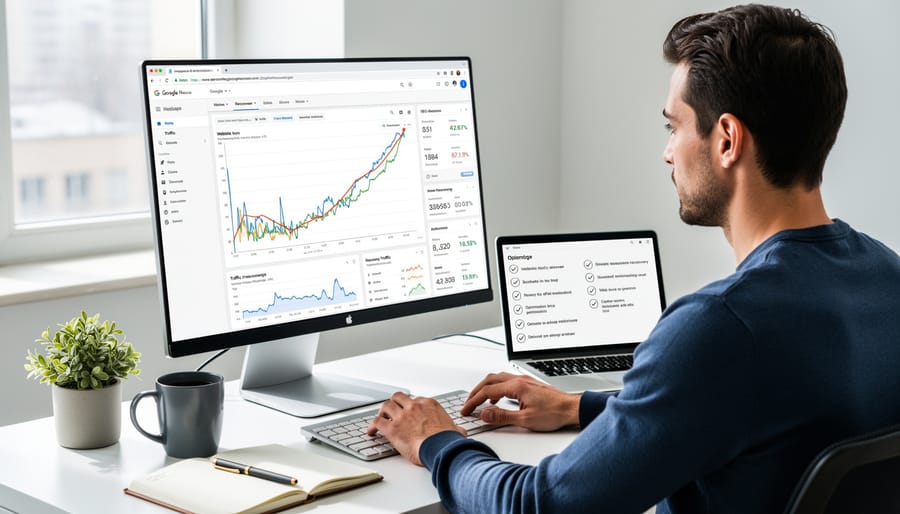
Timeline and Traffic Results
Recovery began March 2023, five weeks after the February core update hit. Traffic stabilized after six weeks of consistent changes, then climbed 47% over baseline by week twelve. The steepest gains appeared between weeks eight and ten, coinciding with the technical fixes and content refresh completing in full.
By September 2023—seven months post-implementation—organic sessions were up 68% year-over-year, with impressions rising 52% and average position improving from 24 to 16. Click-through rate lifted from 2.1% to 3.4%, suggesting relevance signals strengthened across the board.
Key inflection point: When the site removed 120 thin listicles and consolidated overlapping how-to guides, rankings for remaining pages jumped within three weeks. Another spike followed the schema and internal linking overhaul in May.
Caveat: Google rolled out two smaller updates during this window, making direct causation hard to isolate. Seasonal trends in the niche also turned favorable in Q2. What’s clear is that aligned fixes correlated with sustained recovery, while competitor sites that waited saw no rebound.
What Didn’t Move the Needle
Not every change drove a measurable lift. The team tested three common SEO fixes that showed negligible impact on rankings or traffic within the six-month window. A site-wide Core Web Vitals sprint—optimizing images, lazy-loading, and reducing JavaScript—improved Lighthouse scores by eighteen points but did not correlate with traffic recovery. Adding structured schema markup for articles and breadcrumbs satisfied rich-result testing tools yet delivered no discernible SERP gains. Minor UX refreshes—button color tests, sidebar repositioning, internal link styling—moved engagement by less than two percent and left organic visibility flat. These tactics may support long-term user experience or future algorithm shifts, but they were not the recovery levers. Prioritize content depth, topical coverage, and E-E-A-T signals first; reserve polish for post-recovery refinement.
Who Should Try This
Try this approach if you run a publisher, reference, or content-heavy site that lost organic traffic after a Google Helpful Content, core, or product-reviews update and suspect thin or AI-generated material triggered the drop. The tactics work best when you can dedicate resources to comprehensive content audits, rewrites, and strategic pruning over several months. Expect measurable ranking improvements within two to four core-update cycles if your domain still holds topical authority and you commit to raising quality across the board—not just patching a few pages. Less effective for e-commerce product pages, local-business sites, or domains penalized for technical SEO or backlink issues rather than content quality.

