

YouTube Affiliate Requirements Changed—Here’s What Actually Matters Now

YouTube’s affiliate program requires 1,000 subscribers and 4,000 watch hours in the past 12 months, plus adherence to monetization policies and community guidelines. Meet these thresholds by publishing consistent, niche-focused content that solves specific viewer problems rather than chasing viral trends. Apply through YouTube Studio once eligible, then connect an approved affiliate network or use YouTube Shopping features to tag products in videos and descriptions. Maintain compliance by disclosing all affiliate relationships clearly in video content and descriptions, avoiding prohibited categories like tobacco or weapons, and ensuring your promotional content aligns with advertiser-friendly guidelines to prevent demonetization or program removal.
What YouTube Actually Requires for Affiliate Links
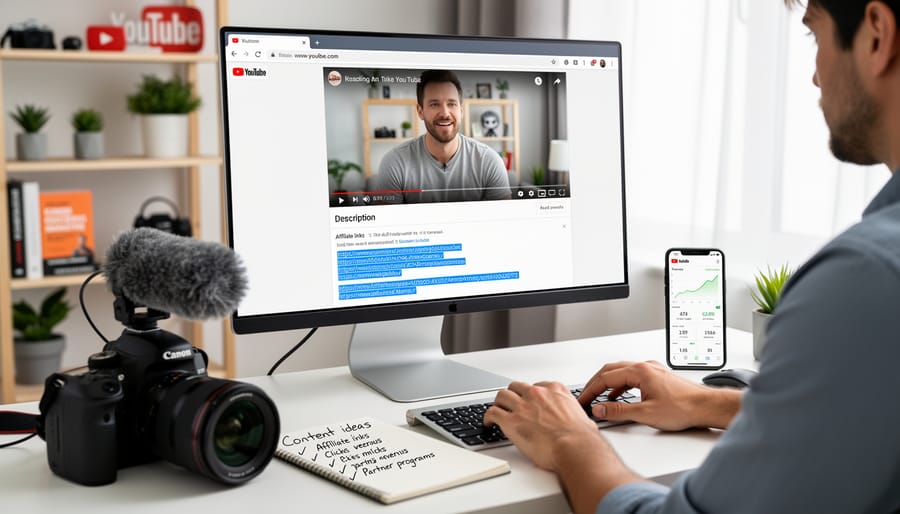
YouTube doesn’t restrict who can post affiliate links in video descriptions—any creator can add them regardless of channel size or monetization status. No minimum subscriber count or watch hours required. This differs from the YouTube Partner Program, which needs 1,000 subscribers and 4,000 watch hours for ad revenue access, but those thresholds don’t apply to affiliate marketing.
The platform does enforce disclosure requirements. You must tell viewers when links are affiliated, typically by adding statements like “Links in this description may earn me a commission” near the top of your description. YouTube’s terms of service require transparency about commercial relationships, and the FTC mandates clear, conspicuous disclosures for U.S. creators.
Beyond disclosure, YouTube’s spam policies matter more than formal eligibility. Avoid description stuffing with dozens of links, don’t post misleading claims about products, and ensure your video content relates to the products you’re promoting. Channels that violate spam guidelines risk strikes or removal regardless of size.
For monetized channels in the YouTube Partner Program, additional advertising-friendly content guidelines apply. Videos with excessive profanity, controversial topics, or certain sensitive content may see limited ad serving, which doesn’t block affiliate links but can reduce overall channel reach.
The practical takeaway: technical barriers are minimal, but compliance with disclosure rules and spam policies is non-negotiable. Most enforcement happens through community reporting and algorithmic detection, so transparent practices protect your channel’s standing while you scale affiliate campaigns across multiple videos.
The Partnership Prerequisites: YPP vs. Affiliate Linking
YouTube’s Partner Program (YPP) and affiliate linking are separate systems with different barriers to entry. YPP requires 1,000 subscribers and 4,000 watch hours (or 10 million Shorts views in 90 days) to unlock ad revenue, channel memberships, and Super Chat. Affiliate linking, however, has no subscriber threshold—any creator can add affiliate links to video descriptions immediately after channel creation, regardless of monetization status.
This matters because you can start earning through affiliate commissions long before qualifying for YPP. A channel with 50 subscribers can legally include Amazon Associates links, course referrals, or brand partnerships in descriptions and pinned comments. YouTube’s terms of service don’t restrict this practice; the platform only requires proper disclosure under FTC guidelines.
The confusion stems from YPP’s Shopping features, which do require monetization status and let creators tag products directly in videos. That’s distinct from manually placing affiliate URLs in your description box. For creators below monetization thresholds, description-based affiliate links remain the primary revenue path—simpler to implement and available from day one. Track which links drive clicks using UTM parameters or dedicated link management tools to identify high-converting content before you ever hit YPP eligibility.
Programmatic SEO Strategies for YouTube Affiliate Content
Video Title and Description Templates That Convert
Effective affiliate videos start with metadata that matches what viewers actually search. Map your keyword research to specific templates: product reviews use “[Product Name] Review 2024 – Worth It for [Use Case]?”; comparisons follow “[Product A] vs [Product B]: Which [Category] Is Better?”; tutorials adopt “How to [Solve Problem] Using [Product] (Step-by-Step)”. Front-load your primary keyword in the first 60 characters of titles.
Descriptions need structure: open with a one-sentence value statement containing your target keyword, insert your affiliate disclosure and link in the first two lines (YouTube surfaces these in previews), then add timestamps for retention signals. Include 3-5 related search terms naturally in the first 200 characters—this is what YouTube’s algorithm indexes most heavily.
For scalability, create spreadsheet templates mapping search intent categories (informational, commercial, transactional) to title formulas and description blocks. Swap variables (product names, feature sets, price points) while maintaining compliance language. Test variants against click-through rate benchmarks: transactional queries convert at 8-12% when titles explicitly promise outcomes. Plain product names underperform question-format titles by roughly 40% for affiliate content.

Batch Creating Affiliate Video Content
Producing multiple affiliate videos per week without burning out requires strategic batching. Film multiple product reviews or comparisons in a single session using consistent lighting, background, and camera setup—this eliminates time wasted on repeated technical configuration. Create a master shot list and script template that standardizes your intro, feature breakdown, pros-cons format, and disclosure placement across videos.
For compliance at scale, build a disclosure checklist into your batch workflow: verbal mentions recorded consistently, pinned comments drafted before upload, and description templates with required FTC language pre-filled. This systematizes compliance rather than treating it as an afterthought for each individual video.
Template-driven editing accelerates post-production. Develop reusable sequences for B-roll, lower thirds displaying product names, and affiliate disclosure overlays. Tools like DaVinci Resolve or Premiere Pro support preset export settings that maintain consistent quality across batches while reducing rendering decisions.
Content calendars prevent keyword cannibalization when publishing high volumes. Map out which products and comparison angles you’ll cover monthly to avoid competing with your own videos in search results. This planning phase identifies gaps in your coverage and prevents redundant content that dilutes performance.
Quality control remains essential even when scaling. Review each video against YouTube’s spam policies and affiliate network terms before scheduling. Batch uploading through YouTube Studio’s scheduled publish feature spaces content releases appropriately and maintains channel velocity without overwhelming subscribers.
Link Management for YouTube Affiliates
Managing affiliate links at scale requires systems, not one-off edits. YouTube creators often maintain dozens or hundreds of videos with links in descriptions, pinned comments, and community posts—each needing tracking parameters, compliance disclosures, and occasional URL updates when merchants change program terms or platforms.
Start with a spreadsheet or dedicated link management tool that logs every video ID, original affiliate link, shortened URL, tracking parameter, and last-updated timestamp. This central repository lets you identify which videos contain outdated links when a merchant migrates from ShareASale to Impact, for example.
Use tagged tracking parameters consistently (utm_source, utm_medium, utm_campaign) to isolate performance by video topic, upload date, or funnel stage. This approach complements tracking affiliate link performance by letting you see which video formats or niches convert best, informing future content planning.
Link rotation—swapping destination URLs without re-editing hundreds of descriptions—works best with custom short domains and redirect management software. When a product discontinues or commission rates drop, update the redirect target once rather than touching every video manually.
For creators promoting two-tier affiliate programs, maintain separate tracking strings for direct commissions versus referrals so you can measure both revenue streams independently.
Schedule quarterly audits: scan top-performing videos for broken links, verify merchant program status, confirm disclosure language meets current FTC guidelines, and test checkout flows. Automation catches most issues, but manual spot-checks prevent revenue leaks from edge cases like geo-restricted offers or cookie duration changes.
Compliance Pitfalls That Kill Channels
Three categories of violations cause most affiliate channel suspensions: disclosure failures, deceptive practices, and restricted product promotion.
Disclosure gaps trigger the majority of compliance issues. The FTC requires clear, unambiguous disclosures before affiliate links appear—verbal mentions like “I earn from qualifying purchases” plus visible text in descriptions. Burying disclosures below the “show more” fold or using vague language like “partnership” instead of “affiliate link” invites enforcement. YouTube’s algorithm now flags videos with affiliate links lacking proper callouts within the first 30 seconds.
Misleading product claims accelerate demonetization. Overstating results, showing fake before/after comparisons, or making health claims unsupported by evidence violates both platform policy and consumer protection law. Even accurate statements become problematic if presented deceptively—testimonials must reflect typical results, not outlier experiences.
Prohibited product categories carry permanent strike risk. YouTube explicitly bans affiliate promotion of weapons, tobacco, controlled substances, counterfeit goods, and certain supplements. Financial products like forex signals or crypto schemes face heightened scrutiny. Channels promoting these categories often lose monetization entirely, regardless of disclosure quality.
At scale, programmatic approaches multiply compliance risk. Automated video generation or bulk link insertion can propagate disclosure errors across hundreds of videos instantly. Review templated disclosures with legal counsel before deployment, maintain audit logs of all affiliate URLs, and implement automated checks for banned product categories in your workflow.

Meeting YouTube’s eligibility thresholds—1,000 subscribers, 4,000 watch hours, adherence to monetization policies—is table stakes for affiliate marketers. The real leverage comes from building repeatable systems: templated video structures that pass review, disclosure workflows that scale across channels, and link management that survives description updates. For programmatic SEO practitioners, YouTube affiliate success hinges on treating compliance as infrastructure, not a one-time checklist. Start by documenting your disclosure language, create reusable video templates that satisfy watch-time requirements, and maintain a central repository of approved affiliate links before you scale production. The channel that grows sustainably is the one where requirements become reproducible processes.

