

Writer Guest Red Flags: How WHOIS Forensics Expose Fake Publishers

“Writer guest” is the WHOIS registrant name stamped on thousands of low-quality guest-post sites, a forensic fingerprint that helps link-builders filter out blog networks and sketchy publishers in seconds. When you query domain registration data for a site offering paid placements, this generic alias often surfaces alongside privacy-shielded contact details, bulk registration dates, and cookie-cutter WordPress installs. It signals a broker or network operator managing dozens of domains under a single identity, exactly the kind of setup that earns manual penalties and dilutes link equity.
SEOs and digital marketers use WHOIS lookups to vet outreach targets before pitching or paying, hunting for clusters of sites registered to the same name, email, or nameserver. A “writer guest” hit suggests the domain exists to sell links rather than publish genuine editorial content. The vetting workflow is simple: run the WHOIS, cross-check registrant patterns, scan for content thin enough to trigger quality filters, and move on if the signals stack up. Publisher transparency matters because search engines reward links from independent, accountable sources, and a proxy registrant is the opposite of that.
What ‘Writer Guest’ Signals in WHOIS and Contact Records
When you pull WHOIS data on a questionable guest-post site, “writer guest” typically appears in one of three places: the registrant name field, the administrative contact, or the organization line. You might see literal “Writer Guest” entries, or close variants like “Guest Writer,” “Writer Post,” or “Post Guest.” These aren’t personal names or business entities, they’re placeholder text that bulk domain registrars or automation scripts insert when someone registers dozens of sites without bothering to customize each record.
Legitimate publishers use their actual names or registered business titles. A travel magazine runs WHOIS under “Wanderlust Media LLC” or the founder’s name. A marketing blog shows “Sarah Chen” or “Chen Digital Consulting.” They treat domain registration as a legal and reputational touchpoint. Generic phrases like “writer guest” signal the opposite: someone who values speed and anonymity over identity.
This footprint clusters heavily with PBNs and content farms because operators register domains in batches, sometimes twenty or fifty at once, using automated checkout flows. Default or throwaway text winds up in mandatory fields, and nobody goes back to clean it up. The same pattern appears in admin email addresses: “[email protected]” or “[email protected]” instead of a real person’s contact.
You’ll also spot these phrases embedded in on-site contact forms or footer copy, often alongside other templated language like “Submit Your Guest Post Here” repeated verbatim across unrelated domains. When WHOIS records and site text both carry the same generic markers, you’re looking at a network built for volume, not editorial standards. Cross-reference the creation date; if ten domains with “writer guest” registrants all launched within a 48-hour window, that’s a factory operation, not independent publishers who happen to accept guest contributions.
WHOIS Forensics Fundamentals for Publisher Vetting

A WHOIS lookup reveals the ownership and registration details behind a domain, essential data for assessing whether a guest-post publisher is legitimate or part of a hidden network. You can run these lookups through public tools like ICANN’s lookup service, domain registrars, or bulk query platforms. The raw output often looks technical, but a handful of fields tell you most of what you need.
Start with the registrant name and organization. A credible publisher typically shows a real company name, individual, or recognizable entity. When you see “Writer Guest,” “Privacy Protected,” or generic placeholders like “Contact Admin” in these fields, dig deeper. Legitimate businesses have no reason to hide their identity behind vague labels, especially when soliciting paid guest posts.
Check the domain creation date. If dozens of domains in a publisher’s network were registered within days or weeks of each other, that clustering suggests bulk acquisition, a hallmark of private blog networks. Single-domain businesses grow over time; mass site operators launch in batches.
Nameservers and hosting details matter too. When multiple domains share identical nameservers or resolve to the same IP address block, it indicates centralized infrastructure. One operator managing ten sites isn’t inherently suspect, but fifty domains on one server with no disclosed relationship raises questions.
Privacy services complicate this picture. Tools like WhoisGuard or Domains By Proxy are legitimate ways to shield personal contact details from spam and harassment. Many solo publishers and small businesses use them without issue. The red flag emerges when privacy protection combines with other obfuscation tactics: no listed business address on the site itself, contact forms that never respond, identical site templates across dozens of domains, and WHOIS records that all point to the same privacy service at the same registrar registered on the same date. That pattern isn’t privacy; it’s concealment at scale.
Red Flags Beyond ‘Writer Guest’

While ‘writer guest’ footprints offer a quick initial filter, seasoned link-builders layer multiple forensic checks to separate legitimate publishers from shell networks. The strongest red flags rarely appear in isolation, they cluster. A domain registered to a generic placeholder might share server space with fifty other sites, all launched the same week, all running identical WordPress themes with minor CSS tweaks.
Bulk registration dates are one of the clearest tells. When you spot five, ten, or twenty domains created within a 48-hour window and all pointing to the same nameservers, you’re likely looking at a batch operation rather than organic growth. Real publishers launch sites sporadically as business needs arise, not in synchronized waves. Cross-reference creation dates with WHOIS history tools or bulk lookup services to surface these patterns quickly.
Shared hosting infrastructure extends the investigation beyond individual domains. If dozens of “independent” guest-post sites resolve to the same handful of IP addresses, especially budget shared hosting blocks, it signals centralized ownership masquerading as a distributed network. Legitimate publishers invest in distinct hosting, often with recognizable providers or dedicated IPs. Tools that cluster domains by IP or nameserver can reveal these hidden ties in seconds.
Identical site templates deserve scrutiny even when branding differs. Many low-effort networks deploy the same theme across properties, changing only logos and color schemes. Look for matching HTML structure, identical plugin footprints in page source, or suspiciously similar layouts in archive pages and author bios. A quick visual scan of five to ten sites from a vendor’s list often exposes template recycling.
| Red flag | What it reveals | How to check |
|---|---|---|
| Bulk registration (10+ domains in 48 hours) | Batch site creation, likely network operation | WHOIS history tools, bulk lookup APIs |
| Shared hosting IP across 20+ domains | Centralized ownership hiding as independent sites | Reverse IP lookup, hosting cluster tools |
| Identical site templates | Low-effort duplication, minimal investment per site | View page source, visual comparison, BuiltWith |
| High DA with negligible traffic | Manipulated metrics, expired domain repurposing | SEMrush, Ahrefs traffic estimates vs. DA score |
| Backlink profile: 90%+ guest posts | Pure link-farm activity, no natural link growth | Backlink analyzers filtering by anchor diversity |
Domain Authority inflation presents another common trap. Sites sporting DA scores in the 40s or 50s but showing near-zero organic traffic in third-party tools often result from expired domain acquisition or manipulated link schemes. Compare the DA against actual monthly visitors, referring domain diversity, and branded search volume. A legitimate site with DA 45 should pull thousands of visits; if it doesn’t, the metric is hollow.
Backlink profile composition closes the loop. Run a sample of domains through any major backlink tool and filter by link type. If 85% or more of a site’s inbound links come from other guest posts, especially posts with exact-match anchors, you’re seeing a link farm in action, not a content publisher earning natural citations. Healthy profiles show a mix: editorial mentions, resource links, social shares, and yes, some guest content, but not a monoculture.
These forensic signals compound when they appear together. A domain registered in a batch, hosted on a shared IP with forty neighbors, running a recycled template, claiming high DA with no traffic, and sporting a backlink profile of pure guest posts is almost certainly part of a network flying ‘writer guest’ flags or similar placeholders in WHOIS. Vet for the cluster, not just the single symptom.
Why It Matters for Link-Building and SEO
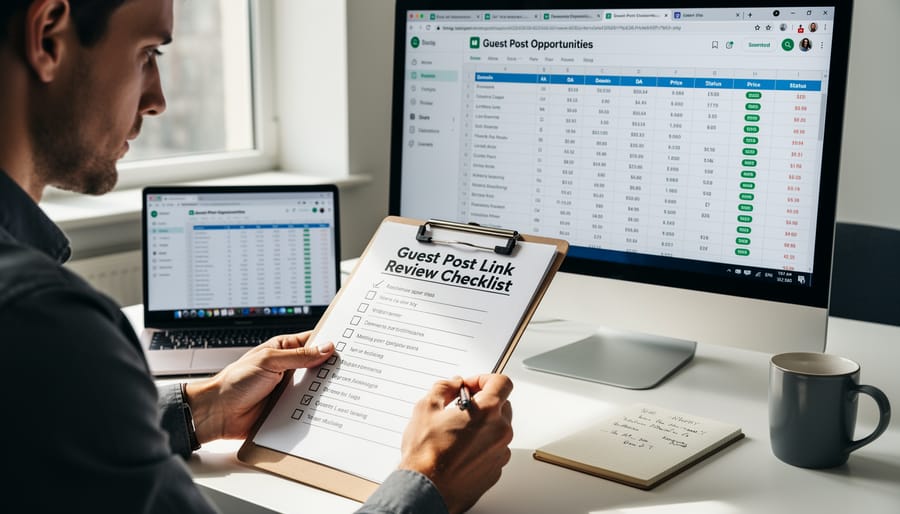
Forensic vetting is not an academic exercise, it is the difference between a link asset and a link liability. When you place a guest post on a site with ‘writer guest’ footprints or other forensic red flags, you are not just buying a link; you are tying your domain’s reputation to a network that search engines actively monitor for manipulation. Google’s spam algorithms treat links from PBNs, bulk-registered domains, and content farms as at best worthless and at worst manipulative. If those sites get deindexed or penalized, your links vanish overnight, or worse, pass negative signals back to your own site. The budget spent is gone, the SEO value is zero, and you may spend months disavowing or recovering from algorithmic hits.
Contrast this with transparent networks and vetted publishers that disclose ownership, show real traffic data, and provide WHOIS details upfront. These publishers can demonstrate consistent organic traffic, diverse backlink profiles, and stable hosting histories because they have nothing to hide. When you can verify a site’s registrant, see its analytics, and confirm it is not part of a mass network, you know your investment will compound over time rather than evaporate. Services that let you inspect WHOIS and traffic metrics before purchase remove the guesswork and shift control back to the buyer.
The ROI equation is simple: one high-quality, forensically clean placement that ranks and drives traffic will always beat ten cheap links on sites that fail basic vetting. The time saved avoiding cleanup work, disavowal campaigns, and rankings recovery is the real value. When you measure guest post value by verifiable metrics, traffic, editorial standards, transparent ownership, you build link equity that lasts, not liabilities that explode later.
Tools and Workflows for Publisher Forensics in 2026
Start with a bulk WHOIS lookup tool that accepts CSV lists and returns registrant data, creation dates, and nameserver information in one pass. Services like WHOIS XML API or Domain Tools offer batch queries; free alternatives include command-line WHOIS clients paired with shell scripts if you’re comfortable parsing text output. Export the results and flag any domains sharing identical registrant names, especially placeholder phrases, or registration dates clustered within a 48-hour window.
Next, cross-reference IP addresses and nameservers using tools like ViewDNS or IPinfo. Group domains by hosting provider and look for unusual concentration, ten or twenty sites on the same IP often indicates a network rather than individual publishers. Compare nameservers across your list; legitimate publishers use diverse hosting, while PBNs often route through a handful of reseller accounts or shared infrastructure.
Run each domain through a backlink analyzer such as Ahrefs, Moz, or Majestic. Check the referring-domain count against traffic estimates from SimilarWeb or SEMrush. A site with 500 referring domains and zero monthly visits is a glaring mismatch. Drill into the backlink profile: if 90 percent of inbound links come from other suspect domains or use identical anchor text patterns, you’re looking at artificial inflation.
Audit sample content manually. Open three or four recent posts on each site. Look for AI-generated filler, duplicate paragraphs across domains, or boilerplate author bios that repeat ‘writer guest’ or similar terms. Check the contact page and footer, real publishers display editorial staff, physical addresses, or media kits; farms leave generic forms or no contact details at all.
Combine these checks into a spreadsheet scorecard: one column per signal, a pass-fail or risk score for each domain. Vet the top-tier prospects first, then decide whether mid-tier sites merit closer review or outright rejection. This workflow takes an hour or two for a list of 50 domains and scales efficiently once templated.
Common Questions About Guest Post Vetting and WHOIS Analysis
Is WHOIS privacy always a red flag?
No. Legitimate publishers often use privacy protection for personal security or regulatory compliance. The red flag emerges when privacy layers combine with other signals: bulk registration dates, shared hosting across dozens of domains, or generic placeholder text like ‘writer guest’ in exposed fields.
How many shared registrants is too many?
A single registrant managing five to ten thematically related sites can be legitimate. When you see the same name or organization tied to 50+ unrelated domains registered within weeks of each other, that’s a network pattern worth avoiding.
Can a flagged site recover credibility?
Yes, if the owner transitions to transparent practices: accurate WHOIS data, original content, genuine traffic sources, and disclosed ownership. Recovery takes months and requires consistent proof that the site now operates above board.
What should I do if I’ve already placed links on suspicious domains?
Document the placements, assess traffic and ranking impact, then decide whether to disavow the links or request removal. If the publisher was sold as a legitimate outlet, escalate with your vendor and verify guest post performance across your entire portfolio to spot similar issues early.
Do forensic checks replace editorial judgment?
No. WHOIS and hosting data reveal ownership and infrastructure patterns, but you still need to evaluate content quality, audience fit, and editorial standards. Use forensics to rule out obvious fakes, then apply editorial criteria to finalists.
These questions surface repeatedly in link-building communities because the line between caution and paranoia shifts as networks adapt. Treat WHOIS forensics as a baseline screen, not a final verdict. Combine technical vetting with traffic verification, content audits, and clear communication with publishers. The goal isn’t perfect information, it’s reducing blind spots enough that you can make informed placement decisions and catch red flags before they cost you rankings or budget.
Spotting “writer guest” in WHOIS records is a useful starting point, but it’s only one signal in a comprehensive vetting process. Real publisher forensics combine domain history, hosting patterns, traffic verification, and content audits to paint a full picture. The industry is moving away from opaque link markets toward verifiable transparency, buyers want to see registrant details, analytics screenshots, and clear editorial guidelines before committing budget. This shift protects both your search rankings and your reputation.
Investing time in upfront vetting pays off. You avoid the distraction and expense of disavowing toxic backlinks, chasing refunds from vanished domains, or recovering from algorithmic penalties. A repeatable forensic workflow lets you stop outreach that fails before wasting resources on fake publishers. When you know what you’re buying, backed by data, not promises, link-building becomes a predictable, high-ROI channel instead of a gamble.

