

How Key Management Services Keep Your Proxy Fleet Secrets Safe

Treat key management services as centralized vaults that generate, encrypt, and rotate secrets across your proxy fleet without embedding credentials in code or config files. When you operate distributed proxies—whether residential, datacenter, or mobile—authentication tokens, API keys, and TLS certificates proliferate fast; KMS solutions programmatically deliver secrets at runtime, automatically revoke compromised keys, and maintain audit logs showing exactly which service accessed what credential and when. Evaluate providers by testing their API latency under load (credential fetches shouldn’t bottleneck proxy requests), verifying they support your secret rotation cadence (daily for high-risk tokens, monthly for internal certificates), and confirming they integrate with your deployment pipeline through SDKs or sidecar containers. The decision between managed cloud KMS and self-hosted Vault hinges on whether you prioritize zero-ops convenience or full control over encryption keys—most proxy operators start with managed services for speed, then migrate sensitive credentials to dedicated hardware security modules as compliance requirements tighten.
What Key Management Services Actually Do
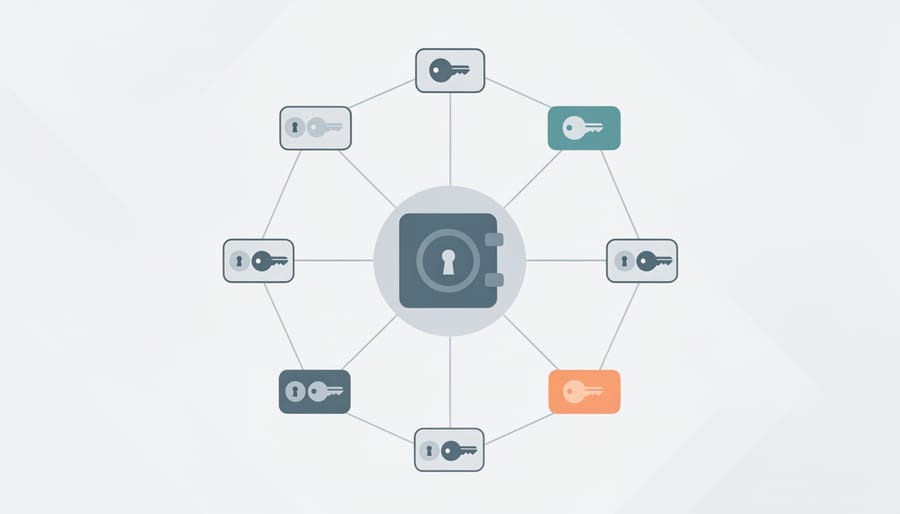
A Key Management Service acts as a secure vault and automation layer for secrets that distributed systems need to operate—think API keys, database credentials, TLS certificates, and encryption keys your proxy fleet uses to route traffic safely.
At its core, KMS handles four essential jobs. First, centralized secret storage: instead of scattering credentials across configuration files or environment variables on dozens of proxy servers, you store them once in an encrypted repository that every authorized service can pull from. Second, encryption key generation and rotation: the system creates cryptographically strong keys on demand and automatically cycles them on a schedule, so a compromised six-month-old key doesn’t compromise your entire infrastructure. Third, granular access control: you define which services, users, or proxy nodes can decrypt which secrets, preventing your load balancer from accidentally accessing database credentials it should never touch. Fourth, audit logging: every secret retrieval, decryption attempt, and permission change gets timestamped and recorded, giving you forensic visibility when something goes wrong.
In a proxy context, this means your edge servers authenticate to the KMS at boot, retrieve fresh TLS certificates and upstream API tokens, then use those credentials for the session. When credentials expire or rotate, proxies fetch updated versions automatically without manual SSH sessions or service restarts. If an attacker compromises one proxy node, audit logs show exactly which secrets were accessed and when, while access policies limit blast radius to that node’s specific permissions. The result: secrets never live in plain text on disk, rotation happens without downtime, and you maintain compliance-ready visibility across your entire fleet.
Why Proxy Fleets Need Dedicated Key Management
The Distributed Secret Problem
When you’re scaling your proxy fleet from ten nodes to hundreds, each proxy needs its own authentication credentials to reach upstream services. That means API keys, bearer tokens, database passwords, and TLS certificates proliferating across every instance in your infrastructure. Manual distribution—whether through environment variables, config files, or SSH—quickly becomes a maintenance nightmare. Each new service integration multiplies the problem: fifty proxies times ten upstream APIs equals five hundred secrets to track, rotate, and revoke. When credentials leak or expire, you’re racing to update configuration across dispersed nodes, often during an outage when time matters most. Static secrets baked into images or orchestration templates create additional exposure—anyone with repository access inherits full credential scope. This explosion of distributed secrets, each with its own lifecycle and blast radius, is precisely what breaks traditional approaches and makes centralized key management essential for production proxy operations.

Attack Surface Across Fleet Infrastructure
When proxy fleets scale beyond a handful of instances, the attack surface expands rapidly. Hardcoded credentials in configuration files or environment variables become the weakest link—one compromised container exposes authentication secrets across your entire deployment. Unrotated API keys compound this risk: static tokens remain valid indefinitely, giving attackers ample time to exploit a single breach. Without automated rotation, teams rely on manual processes that rarely happen until after an incident.
Lateral movement becomes trivial when multiple proxies share identical credentials. An attacker who compromises one node inherits access to upstream services, internal APIs, and adjacent infrastructure. This makes monitoring your proxy fleet essential but insufficient—you need secrets management that assumes breach and limits blast radius. Key management services address these vulnerabilities by centralizing credential distribution, enforcing time-bound tokens, and enabling granular access policies per proxy instance rather than fleet-wide shared secrets.
Core KMS Features for Proxy Fleet Security
Centralized Secret Storage and Retrieval
Instead of embedding secrets in configuration files or environment variables, modern proxy architectures fetch credentials at runtime from a centralized KMS. When a proxy needs to authenticate with an upstream API or database, it makes an authenticated request to the KMS, retrieves the secret, uses it for the connection, then discards it from memory. This on-demand pattern eliminates secret sprawl across servers and enables instant rotation without redeploying code.
Common integration patterns include REST APIs where proxies authenticate using short-lived tokens or instance identity, then request specific secrets by name or path. Libraries abstract the fetch logic, automatically handling retries, caching for performance, and lease renewal. Some systems inject secrets as time-limited environment variables on process startup, while others provide SDK methods that return credentials synchronously.
The shift from static configuration to dynamic retrieval means proxies stay lean and stateless. Only the KMS stores secrets persistently, simplifying audits and access control. When a secret leaks or expires, updating it centrally immediately affects all connected proxies without configuration changes or restarts.
Automated Key Rotation
Manual credential updates create risk windows and deployment friction. Automated rotation policies let you define lifecycle rules—rotate proxy auth tokens every 30 days, renew TLS certificates 14 days before expiry, cycle upstream API keys quarterly—and the KMS executes them without human intervention or service interruption.
Modern KMS implementations coordinate rotation across distributed proxy fleets by issuing new credentials before old ones expire, allowing overlap periods where both versions authenticate simultaneously. Proxies fetch updated secrets on their next sync cycle, typically every few minutes, ensuring zero downtime during transitions.
The rotation process tracks version history and provides rollback capabilities if newly issued credentials fail validation. Most systems emit alerts when rotation fails or when credentials approach expiry without configured policies. This prevents the emergency scrambles that happen when manually managed secrets expire unexpectedly in production.
For compliance-heavy environments, automated rotation creates audit trails showing when each credential changed, who approved the policy, and which systems received updates—satisfying security frameworks that mandate regular key cycling without adding operational overhead.

Granular Access Controls
Modern KMS platforms enforce role-based access control (RBAC) so only authorized proxy nodes retrieve specific secrets. Instead of granting blanket permissions, you assign granular policies: Node A fetches API keys for payment gateways; Node B accesses database credentials; Node C gets nothing. This implements the principle of least privilege—each service sees only what it needs to function, limiting blast radius if one node is compromised. Attribute-based policies add further nuance, restricting access by environment (staging versus production), time windows, or network origin. Why it matters: Reduces lateral movement risk and simplifies audit trails. For: Platform engineers managing multi-tenant or microservice architectures where secret sprawl creates compliance headaches.
Audit Trails and Compliance
Every access to a secret—who requested it, when, from which service—gets logged to an immutable audit trail. This matters for two reasons: forensic investigations after a breach and proving compliance with SOC 2, PCI-DSS, or GDPR requirements that demand accountability for sensitive data. Modern KMS platforms flag anomalous patterns like a credential accessed 10,000 times in an hour or queried from an unexpected geographic region, giving security teams early warning of compromised keys. Combined with proxy infrastructure visibility, these logs transform secrets management from a black box into a defensible, auditable system where every touch leaves a traceable fingerprint.
Common KMS Options and When to Use Each
Choosing a KMS depends on where your infrastructure lives, how much control you need, and what your team can realistically manage.
AWS KMS integrates natively with the broader AWS ecosystem—use it if your proxies run on EC2 or Lambda and you want automatic integration with IAM policies and CloudTrail logging. It handles encryption keys without exposing them to your application code, making it straightforward for teams already invested in AWS tooling. Pricing scales with API calls, so high-volume proxy fleets should budget accordingly.
Azure Key Vault and Google Cloud KMS follow similar patterns for their respective clouds. Azure Key Vault supports hardware security modules and certificate management alongside secrets, useful if you’re managing TLS termination for proxies. Google Cloud KMS emphasizes fine-grained IAM controls and integrates cleanly with GKE for containerized proxy deployments.
HashiCorp Vault stands apart as cloud-agnostic. It runs anywhere—on-premises, multi-cloud, or hybrid environments—and offers dynamic secrets that rotate automatically, reducing exposure windows when proxy credentials leak. The tradeoff is operational complexity: you’re responsible for running, securing, and scaling Vault itself. Best for teams with strong ops capabilities or existing HashiCorp infrastructure.
Selection criteria: Start with your cloud provider’s native KMS if you’re single-cloud and want minimal operational overhead. Choose Vault for multi-cloud environments, dynamic secret generation, or when vendor lock-in concerns outweigh operational cost. Evaluate based on your proxy fleet size, rotation frequency requirements, compliance mandates, and whether your team has bandwidth to manage infrastructure beyond the proxies themselves.
Implementation Patterns That Work
Here are four patterns teams actually use to integrate KMS into production systems:
Sidecar containers handle secret injection before application startup. A lightweight container fetches credentials from KMS, writes them to a shared volume, then signals the main application container. This keeps secrets logic separate from business code and works across orchestration platforms.
Why it’s interesting: Decouples authentication logic from every service you build, making rotation and auditing centralized.
For: Platform engineers running containerized workloads
Init scripts fetch credentials at boot time for simpler deployments. The application calls KMS APIs during initialization, caches decrypted secrets in memory, and refreshes them on a schedule. Best for monolithic services or distributed proxy architecture where startup latency matters less than operational simplicity.
Why it’s interesting: Minimal infrastructure overhead—just add SDK calls and configure IAM permissions.
For: Teams without Kubernetes wanting immediate KMS benefits
Service mesh integration leverages Envoy or Linkerd to inject secrets as environment variables or mount points. The mesh control plane handles KMS communication, authentication, and rotation, exposing a simple interface to workloads.
Why it’s interesting: Secrets become infrastructure concerns rather than application responsibilities.
For: Organizations already running service mesh
Environment-specific namespacing isolates dev, staging, and production secrets using KMS key hierarchies or path prefixes. Each environment authenticates with scoped IAM roles that restrict cross-environment access.
Why it’s interesting: Prevents accidental production credential leaks during testing.
For: Security-conscious teams managing multiple deployment stages
Key management services turn what could be scattered liabilities—API keys in config files, credentials in environment variables, certificates buried in deployment scripts—into managed, auditable assets with lifecycle policies and access controls. The shift from ad-hoc secrets handling to centralized KMS reduces breach surface area, simplifies credential rotation, and creates a single source of truth for security teams.
Start small rather than attempting a complete secrets overhaul. Choose one high-risk secret type—say, database credentials or third-party API tokens—and migrate it to KMS first. Measure the operational impact: rotation frequency, access audit trails, time saved during onboarding. Once the pattern proves stable, expand incrementally to additional secret types across your proxy infrastructure.
The journey from decentralized secrets to managed infrastructure isn’t instantaneous, but each secret migrated into KMS compounds security posture and operational confidence. For distributed proxy systems handling authentication at scale, the question isn’t whether to adopt key management—it’s how quickly you can begin.

