

How Black Hat Hackers Stay Invisible at DEF CON and Black Hat (And What SEOs Can Learn)

Borrow threat models from DefCon and Black Hat conferences to mask automated link building operations. Treat search engine crawlers as adversaries conducting reconnaissance, then architect your automation to mimic organic human patterns: randomize request intervals between 3-47 seconds, rotate residential IP addresses across different ASNs and geographies, and fingerprint your user agents to match real browser telemetry including canvas hashes and WebGL parameters. Deploy honeypot detection by testing new link targets manually before automation touches them—if a site serves different content to suspected bots versus humans, your automation becomes immediately visible.
Segment your operations into isolated cells where each automated instance maintains a distinct digital identity, complete with unique cookie histories, timezone consistency, and behavioral profiles that age naturally over months. Security researchers call this tradecraft “operational security”; for link builders, it means your automation becomes indistinguishable from a distributed team of careful human operators, each building links at sustainable, undetectable velocity.
What DefCon and Black Hat Teach About Digital Anonymity
The Core OpSec Principles
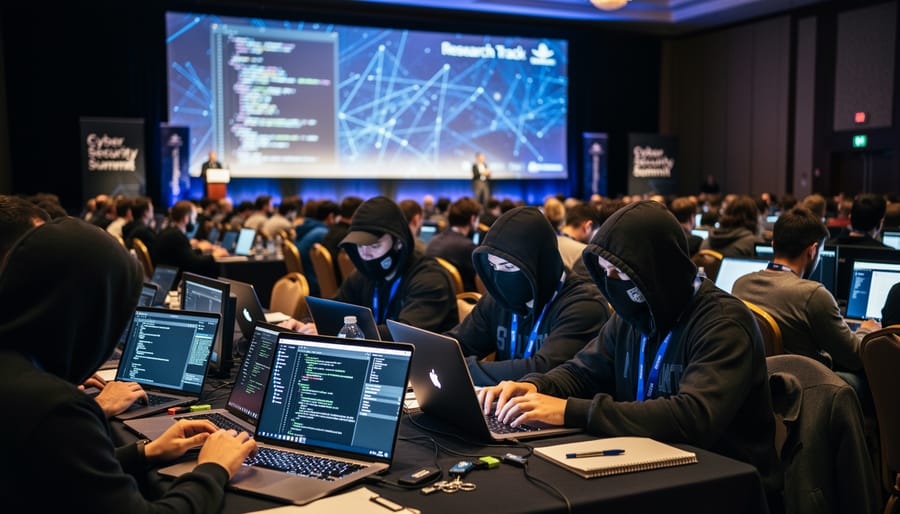
Professional operators at DefCon and Black Hat conferences adopt three foundational practices to avoid attribution and detection. Pattern disruption means varying timing, volume, and sequencing of activities so automated monitoring systems can’t flag regular behavior. If you scrape Monday at 9am every week, you will be caught. Identity compartmentalization isolates each operation behind separate infrastructure, credentials, and digital footprints—a principle essential to understanding how black hat networks work. Behavioral randomization introduces controlled noise: randomized user agents, request intervals with gaussian distribution, and geographically distributed exit nodes. Together, these principles create operational invisibility not through sophistication alone, but through disciplined inconsistency.
For: SEO practitioners, automation engineers, privacy-focused researchers.
Why it matters: Detection systems hunt patterns; eliminating predictability makes your automated activities indistinguishable from organic traffic at scale.
Why Footprint Matters More Than Tools
Defenders don’t flag individual link placements or single requests. They identify adversaries through cumulative patterns: velocity spikes, timing repetition, identical user agents across IPs, sequential targeting of similar domains. A clean proxy or fresh user agent protects one action, but automated link building generates thousands of actions that form recognizable signatures. Security teams at DefCon emphasize this gap between operational security and tactical security—using Tor once is tactical; using it the same way 500 times creates an operational fingerprint. Your footprint is the aggregate behavioral pattern left across all requests, accounts, and targets over time, not the individual technical choice in any single moment.
The Automation Footprint Problem in Link Building
Recognizable Pattern Signatures
Automated link networks leave fingerprints. When dozens of sites use identical anchor text ratios—say, 40% exact-match, 30% partial, 30% branded—search engines flag the uniformity. Similarly, simultaneous link placements across multiple domains within hours trigger automated attack detection patterns designed to spot coordinated manipulation. Template-based content compounds the problem: if 50 articles follow the same structure (intro, three bullet points, call-to-action) with only keyword swaps, algorithms recognize the scaffolding.
Why it matters: Detection systems scan for variance. Human editors naturally create inconsistency—different anchor distributions per site, staggered publication schedules, unique content architectures. Automation favors efficiency over randomness.
For: SEO practitioners working with link networks who need to understand what triggers algorithmic penalties, or teams auditing existing backlink profiles for detectable patterns before competitors or search engines notice them.
The PBN Detection Arms Race
Search engines deploy pattern-matching algorithms that analyze WHOIS registration data, looking for clusters of domains registered on the same date, with identical registrant information, or using privacy services in predictable ways. Hosting footprints matter: multiple sites on the same IP address, C-block, or datacenter raise red flags, especially when those sites link to each other or share similar templates and content management systems.
Cross-link topology analysis examines how sites reference one another. Natural link graphs are messy and asymmetric; PBNs often form suspicious hub-and-spoke patterns or dense reciprocal clusters. Google’s algorithms measure link velocity, shared DNS records, overlapping analytics tracking codes, and even stylistic similarities in content.
Detection methods mirror techniques that catch black hat SEO bots: behavioral fingerprinting, timing analysis, and infrastructure correlation. The most sophisticated networks diversify everything—registrars, hosts, themes, posting schedules—while maintaining plausible editorial independence. Less careful operators leave cascading footprints that algorithms now detect at scale, triggering manual reviews or algorithmic devaluation across entire network clusters.

Evasion Techniques from the Black Hat Playbook
Randomize Everything That Can Be Randomized
Pattern recognition is how automated abuse detection catches you. The solution: introduce entropy at every possible touchpoint.
Temporal spacing matters most. Never post links at fixed intervals—use a randomizer that draws from a realistic human distribution (30 minutes to 8 hours), not a simple plus-or-minus jitter. Include occasional multi-day gaps. Real users don’t work weekends identically to weekdays.
Anchor text distribution should mirror organic linking. Roughly 60-70% branded or naked URLs, 15-20% generic (“click here,” “read more”), and only 10-15% keyword-rich. Vary capitalization and punctuation naturally. Track global anchor text ratios across your entire footprint, not per-campaign.
Content length variation prevents fingerprinting. If posting comments or guest content, pull from a range: 80-word quick takes, 200-word standard responses, occasional 500-word deep contributions. Use sentence-level randomization—swap synonyms, reorder clauses, vary punctuation density.
User-agent rotation needs depth. Rotate full browser profiles (headers, screen resolution, timezone, accept-language) as coherent sets. Outdated user-agents signal automation. Maintain 8-12 realistic profiles and cycle them with session persistence—don’t switch mid-interaction.
Why it’s interesting: These micro-variations compound into undetectable patterns that pass both algorithmic and manual review.
For: Growth engineers, agency operators running scaled outreach.
Post-Placement Adaptation
Static backlinks freeze in time while the web evolves around them. Target pages move, disappear, or change content, leaving your carefully-placed links pointing nowhere or to irrelevant material. Worse for detection: links that never change exhibit unnatural permanence that pattern-matching algorithms flag instantly.
Post-placement modification breaks this signature. Updating anchor text weeks after publication mimics natural editorial refinement. Adjusting target URLs when content migrates demonstrates authentic maintenance behavior. Real site owners revisit old posts, fix broken links, and optimize underperforming content; automated systems rarely do.
The Living Links approach systematically schedules post-placement updates based on behavioral norms: minor anchor refinements 2-4 weeks post-publication, URL corrections when targets shift, and gradual optimization informed by engagement data. This ongoing adaptation erases the “set and forget” pattern that distinguishes bots from humans. Detection systems trained on static insertion patterns miss links that evolve like genuine editorial assets. Each modification refreshes the link’s behavioral profile, resetting detection windows and extending operational lifespan beyond typical automation signatures.

Transparency as Counter-Intelligence
The most effective disguise isn’t invisibility—it’s looking exactly like what you claim to be. Instead of hiding link operations behind private blog networks or cloaked domains, build measurable properties with real traffic, engagement signals, and defensible metrics. Search engines and competitors can inspect your footprint, but what they find appears legitimate: genuine user behavior, documented traffic sources, verifiable backlink profiles.
This approach inverts traditional OpSec. Rather than evading detection mechanisms, you pass them. When an algorithm flags your network for review, clean data withstands scrutiny. Public-facing analytics dashboards, transparent authorship, and consistent brand signals create plausible deniability. Your automation becomes indistinguishable from scaled manual effort—which is precisely the point.
The trade-off: higher operational overhead and slower velocity. The payoff: sustainability. Networks built this way survive algorithm updates because they genuinely deliver value signals that align with ranking factors, regardless of how those signals were produced.
Building an OpSec-Ready Link Strategy
Pre-Deployment Footprint Audit
Before deploying any automated link-building campaign, run a systematic check across four critical vectors. First, verify domain diversity: no single domain should appear in more than 15% of your total footprint, and IP address ranges should span at least three Class C blocks. Second, audit content uniqueness using tools like Copyscape or similar plagiarism detectors; aim for 80%+ uniqueness scores across all deployed assets. Third, analyze timing patterns by plotting submission timestamps—natural campaigns show irregular intervals with gaps, not metronomic consistency. Fourth, validate anchor text distribution against known safe ratios (roughly 70% branded/natural, 20% topical, 10% exact-match at most). Document baseline metrics for each vector before launch. This pre-flight audit catches the technical tells that automated detection systems flag first: identical registration dates, synchronized update schedules, template-matching content patterns, and suspiciously perfect distribution curves that human behavior never produces.
Ongoing Maintenance and Adaptation
Your automation profile won’t stay hidden by itself. Security postures degrade without active maintenance, and the same applies to link building OpSec.
Schedule quarterly audits of your footprint. Review anchor text distributions across campaigns—sudden spikes in exact-match phrases trigger algorithmic flags. Rotate language patterns every 60-90 days. Check whether your user agents, IP blocks, or timing signatures have become predictable. Compare current link velocity against historical baselines to spot drift before platforms do.
Update your toolchain when vendors push patches or new fingerprinting defenses emerge. Monitor security forums and SEO communities for reports of detection methods spreading across platforms. If a technique burns (gets widely detected), retire it immediately rather than squeezing out a few more placements.
Document what works and what fails. Threat models evolve. A tactic that passed unnoticed six months ago may now trip automated filters as platforms share detection signatures. Treat your approach as versioned software—test changes in isolated environments, roll back when detection rates climb, and maintain redundant methods so no single countermeasure cripples your entire operation.
Why it’s interesting: Prevents the slow accumulation of detectable patterns that eventually collapse even sophisticated operations.
For: Growth leads and technical SEOs managing long-term automated campaigns.
When API Control Becomes Essential
API control becomes critical when manual intervention breaks operational security. If you’re managing hundreds of backlinks across campaigns, editing each one individually creates browser fingerprints, IP patterns, and temporal signatures that surveillance tools can correlate. Automated systems let you rotate link destinations, update anchor text distributions, or purge compromised assets in seconds—not hours—reducing your exposure window. Security researchers running attribution-sensitive projects use programmatic access to compartmentalize operations: one API key per campaign, disposable tokens for high-risk modifications, automated credential rotation to prevent linkage. When a competitor or platform starts mapping your network, speed matters. API-driven link management lets you adapt faster than manual detection cycles, maintaining the asymmetric advantage that defines effective OpSec at scale.
The Real Lesson from Black Hat Conferences
Black Hat and DefCon conferences reveal a counterintuitive truth about operational security: the most successful actors don’t rely on unbreakable tools or secret exploits. They succeed by building systems that adapt faster than defenders can respond.
Presentations at these conferences consistently show that sophisticated operations prioritize behavioral unpredictability over technical perfection. Automated systems that follow rigid patterns eventually generate signatures that defensive tools can fingerprint. The practitioners who remain undetected treat their tooling as disposable—constantly rotating user agents, varying timing intervals, and deliberately introducing noise that makes pattern recognition expensive.
This explains why commercial security products lag behind threat actors. By the time a defensive signature ships, capable operators have already shifted tactics. The real asymmetry isn’t technical sophistication; it’s adaptation velocity.
For link building automation, this translates to a specific implementation philosophy: build systems that can vary their behavior without manual reconfiguration. Hard-coded delays and static IP rotation schedules create detectable rhythms. Instead, introduce randomness in request timing, vary the sequence of actions across sessions, and periodically audit your traffic patterns as an outsider would see them.
The professionals presenting at these conferences don’t showcase perfect evasion. They demonstrate frameworks for continuous testing and rapid iteration. Their operations assume detection will eventually happen and build recovery mechanisms accordingly.
The lesson isn’t about finding the perfect automation configuration. It’s about accepting that no configuration remains effective indefinitely and building systems designed to evolve. Staying invisible requires treating your operational patterns as hypothesis tests, not final solutions.
Modern link building mirrors operational security: both demand you control your signature, adapt to detection, and own your infrastructure. The hacker ethos from DefCon and Black Hat isn’t about evading responsibility—it’s about maintaining leverage through transparency on your terms. Run your own proxies, rotate realistic user agents, time requests like human behavior, and document everything so you can pivot when platforms update their tripwires. This approach isn’t paranoia; it’s sustainable automation. When you treat footprint management as a technical discipline rather than a shortcut, you build systems that scale without triggering alarms. The best operators don’t hide—they blend by understanding what normal looks like, then engineering it at scale. Control beats concealment. Adaptability outlasts any single tactic. And owning your stack means nobody else decides when your operation goes dark.

