

CAPTCHA Bots Are Winning (Here’s How They Actually Work)

CAPTCHA systems stand as digital gatekeepers, designed to separate human visitors from automated bots—but captcha bots now solve these puzzles at scale using machine learning, OCR technology, and distributed human solver networks. These automation tools process thousands of challenges hourly, enabling everything from bulk account creation to high-volume data scraping, fundamentally reshaping how businesses think about bot defense and authentication. Understanding captcha bots requires examining three core mechanisms: computer vision models trained on millions of labeled images that crack visual puzzles with 85-95% accuracy, audio recognition systems that parse distorted speech challenges, and hybrid services combining AI with crowdsourced human solvers who complete puzzles for fractions of a cent. The arms race between captcha creators and solver developers has pushed both sides toward increasingly sophisticated techniques—Google’s reCAPTCHA v3 now analyzes behavioral patterns and risk scores rather than explicit challenges, while bot developers respond with browser fingerprint spoofing and mouse movement simulation. For marketers, SEO professionals, and security teams, captcha bots represent both opportunity and threat: they power legitimate automation workflows while enabling competitor scraping, review manipulation, and inventory hoarding that distorts market dynamics and user experiences.
What CAPTCHA Bots Actually Are
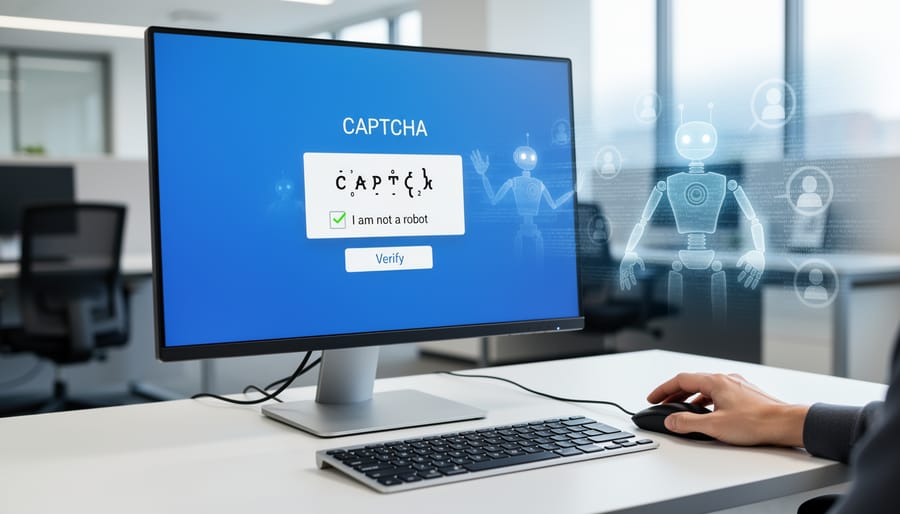
CAPTCHA bots are automated systems designed to solve or bypass the puzzles meant to distinguish humans from machines. At their core, they reverse-engineer the very tests intended to stop them—reading distorted text, identifying traffic lights in image grids, or mimicking mouse movements that look human.
Three main approaches power these systems. AI-powered solvers use computer vision and machine learning models trained on millions of CAPTCHA examples to crack challenges in milliseconds. Human-powered farms outsource puzzle-solving to low-wage workers across distributed call centers—typically solving each CAPTCHA for fractions of a cent. Hybrid systems combine both: AI handles simple cases while farming out harder challenges to human operators, optimizing for speed and cost.
Legitimate applications exist. Accessibility tools help users with visual impairments navigate CAPTCHA-gated services that lack proper alternatives. Researchers use solvers to test security systems or gather public data at scale.
Most deployment happens in grayer territory: ticket scalping, account creation for spam networks, review manipulation, web scraping that violates terms of service, and SEO automation that floods competitors or games search rankings. The technology itself remains neutral—a tool that amplifies either legitimate access needs or systematic abuse depending on intent.
Understanding how these bots function matters whether you’re defending infrastructure, evaluating automation tools, or assessing why certain online behaviors scale impossibly fast.

How Modern CAPTCHA Solvers Break Through
Computer Vision and Machine Learning Models
Modern CAPTCHA-solving bots rely on optical character recognition (OCR) and convolutional neural networks trained on datasets containing millions of labeled CAPTCHA images. These systems use image segmentation to isolate individual characters from distorted text, removing background noise and normalizing letter shapes before feeding them into classification models. Pattern recognition algorithms detect predictable spacing, color schemes, and font choices that many CAPTCHA generators reuse. Sophisticated solvers employ ensemble methods, combining multiple neural networks to achieve accuracy rates above 90% on common text-based CAPTCHAs. Transfer learning accelerates training by adapting pre-trained vision models to CAPTCHA-specific tasks, reducing the data and compute required. Some services crowdsource human solvers as fallback when automated recognition fails, creating hybrid systems that blend machine speed with human perception. Adversarial training—where models learn from their own failures—continuously improves performance against evolving CAPTCHA designs.
Why it’s interesting: These techniques demonstrate how quickly machine learning catches up to human-level perception tasks once sufficient training data exists.
For: Researchers studying adversarial AI, developers evaluating authentication systems, security engineers assessing automated threat models.
Human Solving Services at Scale
When automated solving fails, CAPTCHA bots route challenges to human workers in real time. Services like 2Captcha, Anti-Captcha, and DeathByCaptcha operate crowdsourced farms where workers—mostly in developing economies—solve reCAPTCHAs, hCaptchas, and image grids for $0.50 to $3.00 per thousand. Typical solve times range from 10 to 40 seconds with 90-95% accuracy.
Integration happens through simple REST APIs: the bot submits a CAPTCHA image or site key, receives a task ID, then polls for the solution. Some services offer browser extensions or Python libraries that handle the workflow automatically. Premium tiers add proxy support and faster queues.
The economics are stark. Workers earn $1-2 per hour while services charge clients 10-20x markup. For attackers, spending $10 to solve 5,000 CAPTCHAs becomes a rounding error when scraping leads or creating bulk accounts. This model scales efficiently—adding capacity just means recruiting more workers—making human solving farms the most reliable bypass method when pixel-perfect evasion isn’t enough.
Browser Fingerprint Manipulation
Modern CAPTCHA systems trigger challenges based on risk signals—mouse movements, request timing, browser metadata—long before you reach a protected page. Smart bots now focus on evasion rather than solving. They spoof canvas fingerprints, inject realistic pointer trajectories, randomize viewport dimensions, and mimic WebGL rendering patterns of legitimate browsers. Tools rotate TLS fingerprints and HTTP/2 settings to match expected device profiles. Session behavior matters: bots pause between actions, scroll gradually, and maintain consistent timezone/language headers. Some inject noise into accelerometer and battery API responses to defeat hardware fingerprinting. The shift is strategic—bypassing detection costs less compute than solving visual puzzles at scale. For security engineers: monitor for statistically improbable consistency across sessions. For automation developers: understand that fingerprint diversity now determines success more than solving capability. The arms race moved upstream, where behavioral plausibility replaces brute-force decoding.
Anti-Bot Evasion Tactics Beyond CAPTCHA
CAPTCHA-solving is just one hurdle in a much larger evasion framework. Sophisticated bot operators layer multiple tactics to mimic legitimate human behavior, making single-layer defenses increasingly ineffective.
Residential proxies form the foundation of credible evasion. Unlike datacenter IPs that scream “bot,” residential proxies route requests through real home connections across different geographies. Services now offer millions of IP addresses with automatic rotation, making geographic fingerprinting nearly useless. This technique costs more but dramatically reduces detection rates, especially when combined with timezone-appropriate activity patterns.
Session management separates amateur scripts from professional operations. Advanced bots maintain consistent browser fingerprints across multiple requests—same canvas rendering, WebGL output, installed fonts, screen resolution, and timezone. They persist cookies correctly, handle redirects naturally, and maintain HTTP header consistency. Any mismatch between claimed identity and actual behavior triggers modern anti-bot systems.
Behavioral simulation adds the final layer of authenticity. Mouse movement libraries now generate naturalistic curves with acceleration patterns and micro-corrections that match human motor control. Timing randomization introduces variable delays between clicks, page loads, and form submissions—eliminating the mechanical precision that reveals automated activity. Some frameworks even simulate typos and corrections in text fields.
Cookie handling extends beyond simple acceptance. Sophisticated systems mimic how real browsers store, send, and update cookies including third-party tracking pixels, local storage values, and session tokens. They respect cache behavior and generate appropriate referer headers that tell a coherent story of browsing history.
This multi-vector approach explains why CAPTCHA alone provides false security. When bots arrive through residential IPs, maintain perfect session continuity, move cursors naturally, and solve visual challenges via AI services, distinguishing them from humans becomes extraordinarily difficult. Defenders must analyze aggregate patterns, velocity metrics, and business logic anomalies rather than relying on single authentication checkpoints. The arms race has moved far beyond asking users to identify traffic lights.
Why SEOs and Marketers Encounter This Tech
Captcha bots surface wherever marketers and SEOs automate tasks at scale. Competitor analysis tools scrape pricing pages, backlink profiles, and keyword rankings—activities that trigger captchas on most platforms. Bulk account creation for social media management, forum participation, or review posting relies on bots that must bypass human verification gates. Automated outreach campaigns sending connection requests or cold emails often encounter captchas when platforms detect repetitive patterns. Comment and forum spam operations, once ubiquitous in link-building, depend entirely on bots that can solve or evade these challenges.
These workflows occupy an ethical gray zone. Scraping public data may be legally defensible but violates most terms of service. Account automation speeds legitimate work but enables spam at industrial scale. The same captcha-solving infrastructure powers both efficiency-seeking agencies and malicious operations—the technology itself remains neutral while applications diverge sharply.
Most practitioners encounter captcha bots indirectly through third-party tools: SEO platforms that promise unlimited scraping, social media schedulers handling dozens of accounts, or data enrichment services pulling contact information. The captcha-solving happens invisibly in the background, abstracted behind APIs and dashboards. Understanding what runs beneath these interfaces matters for three reasons: assessing legal risk, evaluating tool reliability when captcha defenses evolve, and recognizing when your own sites face bot traffic. The line between marketing automation and abuse depends less on the technology than on volume, consent, and intent.
The Arms Race: Detection Gets Smarter
Platforms evolved quickly once captcha-solving services became commoditized. Modern defenses focus less on challenges humans can see and more on signals bots can’t fake.
Google’s reCAPTCHA v3 abandoned visible puzzles entirely, instead assigning risk scores based on mouse movements, browsing patterns, device fingerprints, and interaction timing. Users never see a challenge—the system simply flags suspicious sessions for additional verification or blocks them outright. hCaptcha follows a similar model, layering behavioral telemetry with proprietary datasets to identify non-human patterns. Cloudflare’s Turnstile operates invisibly in most cases, analyzing cryptographic proof-of-work, JavaScript execution quirks, and TLS handshake details to distinguish browsers from scripts.
Behind these visible services sits a broader arsenal: honeypots designed to attract automated traffic, machine learning models trained on billions of legitimate sessions, and risk-scoring engines that weigh account age, IP reputation, and session anomalies. The goal isn’t perfect detection—it’s raising the cost of evasion high enough that most operators give up.
This creates an escalation cycle. Solver services adopt headless browser detection countermeasures, emulate realistic mouse curves, and rotate residential proxies. Platforms respond with deeper behavioral analysis and tighter fingerprinting. Each innovation in evasion prompts a detection upgrade, and vice versa.
For practitioners focused on detecting automated attacks, understanding this leapfrog dynamic matters more than any single technique—what works today may fail tomorrow as both sides iterate.

What This Means for Your Workflow
If you rely on automation to scale outreach or testing, understand the legal and ethical boundaries: automated CAPTCHA solving often violates Terms of Service and may expose you to liability. Consider whether the speed gain justifies the risk of IP bans, account terminations, or worse.
If you’re defending a site against bots, single CAPTCHAs aren’t enough. Layer defenses: combine challenge types, monitor behavior patterns like mouse movements and timing, use rate limiting, and watch for suspicious traffic spikes. Modern threats adapt quickly, so static defenses fail.
For legitimate link-building or outreach, transparent services exist that don’t require evasion tactics: manual prospecting, publisher partnerships, and API-based integrations comply with platform rules and avoid the cat-and-mouse game entirely. Automation should simplify workflows, not create technical or legal liability.

