

Why DNS Segmentation Stops Attacks Your Firewall Misses

DNS translates human-readable domain names into IP addresses that computers use to locate each other—think of it as the internet’s phone book. Nameservers are the specialized machines that store and serve these DNS records, answering billions of lookup requests every day to keep websites, email, and cloud services running.
Separating nameserver functions by role (authoritative vs. recursive) and physical location creates resilient architecture that limits blast radius during attacks or outages. When one nameserver segment fails or gets compromised, the isolation prevents cascading failures across your infrastructure. This segmentation strategy matters most for organizations managing multiple domains, handling sensitive traffic, or meeting compliance requirements where downtime carries financial or regulatory consequences.
Implementation ranges from simple geographic distribution of existing nameservers to sophisticated policies that route different query types through dedicated server pools. The approach you choose depends on your threat model, budget constraints, and existing infrastructure—not every network needs full segmentation, but understanding the tradeoffs helps you make deliberate architecture decisions rather than inheriting default configurations that may not match your risk profile.
What DNS Segmentation Architecture Actually Does

Internal vs. External Nameserver Separation
Split-horizon DNS—also called split-view DNS—runs two separate nameservers: one answers queries from internal networks, another handles public internet requests. Internal nameservers resolve private hostnames (like database.internal.company.com) that should never leak outside, while external nameservers only know about public-facing services. This architectural boundary prevents attackers from enumerating your internal infrastructure and reduces the attack surface exposed to the internet.
The security benefit is immediate: your internal DNS can’t be queried by outsiders probing for vulnerable hosts or mapping your network topology. Performance improves too—internal queries resolve faster without routing through external infrastructure, and you can tune caching policies differently for each audience.
Implementation typically means running BIND views, separate DNS server instances, or leveraging cloud provider features that enforce query-source filtering. The tradeoff is added complexity in configuration management and certificate validation when internal and external names diverge.
For: Network engineers, security architects planning segmentation, or operations teams managing hybrid cloud environments where clear trust boundaries matter.
Why it’s interesting: A simple architectural split that delivers both zero-trust principles and practical performance gains without exotic tooling.
Authoritative vs. Recursive Nameserver Zones
Nameservers split into two distinct roles: authoritative servers answer queries about domains you own, while recursive servers resolve queries on behalf of your users. An authoritative nameserver holds the truth—it stores the zone file for example.com and responds with canonical answers when asked. A recursive nameserver acts as an intermediary, chasing down answers across the DNS hierarchy for clients who don’t know where to look.
Running both functions on the same server creates unnecessary risk. Recursive resolvers face the public internet constantly, fielding requests from potentially malicious actors who can probe for vulnerabilities or launch amplification attacks. Authoritative servers need only respond to queries about your specific zones—a much narrower attack surface.
Separation limits blast radius. If attackers compromise a recursive resolver through cache poisoning or exploit, your authoritative data remains isolated. Conversely, a targeted attack on your authoritative infrastructure won’t expose internal client query patterns or enable broader reconnaissance.
For: Network administrators planning DNS infrastructure, security teams conducting threat modeling.
Why it matters: Reduces the likelihood that a single compromise cascades across your naming infrastructure, following the principle that services handling untrusted input should remain isolated from those serving trusted data.
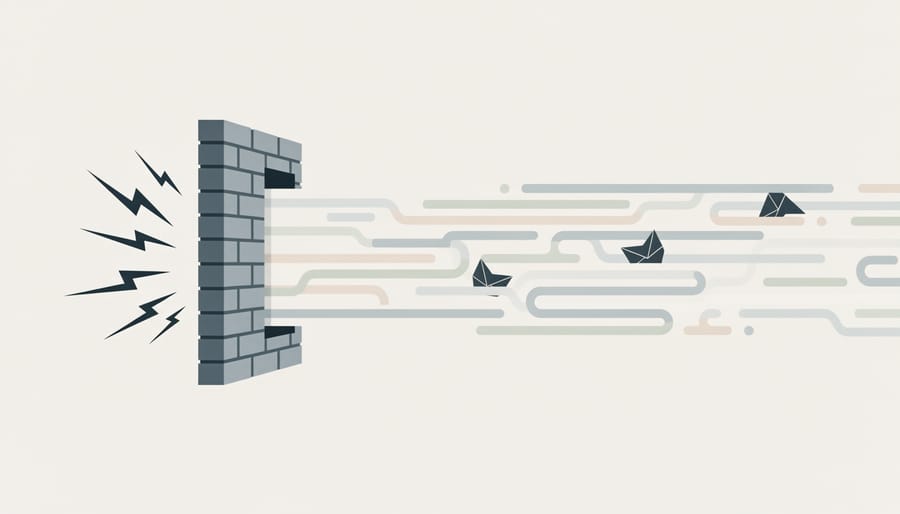
Three Threats This Architecture Blocks
Cache Poisoning Containment
Cache poisoning works by injecting false DNS records into a resolver’s cache, redirecting users to malicious servers without their knowledge. When an attacker successfully poisons one nameserver, every query it handles becomes a potential attack vector until the corrupt entries expire or administrators detect the breach.
Segmented resolver architecture contains this damage by limiting how many clients any single nameserver can affect. If you maintain separate recursive resolvers for production, staging, and employee networks, a compromised staging resolver won’t poison production queries. This isolation mirrors broader containment strategies that assume breach and design accordingly.
Implementation detail: Configure separate cache directories and distinct upstream forwarders for each resolver instance, ensuring poisoned data cannot spread laterally across your infrastructure.
DDoS Amplification Isolation
DNS amplification attacks exploit open recursive resolvers by sending spoofed queries that generate large responses directed at victims—turning your infrastructure into an unwitting weapon. Separating recursive resolvers from authoritative nameservers limits this risk: authoritative servers only answer queries about domains they manage, refusing to perform recursion for arbitrary requests. This boundary prevents attackers from abusing your servers to flood targets with amplified traffic. Operationally, run authoritative servers on separate IPs with recursion disabled, and restrict recursive resolvers to trusted networks or authenticated users only. The architectural split reduces your attack surface while clarifying operational responsibilities—authoritative servers face the internet with minimal functionality, while resolvers serve internal or controlled populations.
Data Exfiltration Detection
Segmenting nameservers by function creates clear DNS traffic patterns that expose anomalies. When internal queries route through dedicated resolvers and external queries through public-facing nameservers, unusual request volumes or domain patterns become immediately apparent. DNS tunneling—where attackers encode stolen data inside DNS queries—generates distinctive traffic signatures: long subdomain strings, high query volumes to obscure domains, or unusual record types. Data exfiltration detection tools can monitor segmented nameservers at network boundaries, flagging recursive queries to suspicious domains before data leaves your perimeter. Split architecture also simplifies firewall rules: internal resolvers need outbound access, but authoritative servers should only answer inbound queries. This asymmetry makes bidirectional tunneling attempts stand out. Network teams can log resolver traffic separately from authoritative responses, making forensic analysis faster when investigating potential breaches.
How to Segment Your Nameservers

Choosing Segmentation Boundaries
Segmentation happens at two layers. Network-layer approaches use VLANs, separate subnets, or firewall rules to isolate nameservers without dedicated hardware—effective for most workloads and easier to manage. Application-layer segmentation runs separate DNS software instances (authoritative vs. recursive, or public vs. internal zones) on shared infrastructure, reducing hardware costs while maintaining logical separation.
Separate physical servers offer maximum isolation against hardware failures, side-channel attacks, and resource exhaustion, making them essential for high-security environments or when compliance mandates air-gapped infrastructure. Virtualized instances provide faster provisioning, simpler scaling, and lower capital expense, acceptable when hypervisor security meets your threat model.
Key tradeoff: Physical separation prevents cascading VM failures and eliminates noisy-neighbor problems but costs more and scales slower. Virtualization reduces operational overhead and enables automated recovery but introduces shared-fate risks if the hypervisor or underlying hardware fails.
For: Infrastructure architects weighing cost against resilience, security teams defining segmentation requirements.
Zone Delegation and Forwarding Rules
Zone delegation allows you to hand off authority for specific subdomains to other nameservers, while forwarding routes queries through intermediate resolvers before reaching authoritative sources. Delegation works by setting NS records that point requests for dev.company.com to a separate nameserver entirely, giving that team full control. Conditional forwarding sends queries matching certain patterns—like internal.corp—to designated resolvers instead of following standard recursion.
In enterprise environments, a typical forwarding chain moves outward: end-user devices query internal recursive resolvers, which forward company zone requests to internal authoritative nameservers, external queries to upstream ISP resolvers or public DNS services like 1.1.1.1, and partner domains to agreed-upon forwarders per trust agreements.
Zone transfers (AXFR for full copies, IXFR for incremental updates) replicate authoritative data between primary and secondary nameservers, ensuring availability if one fails. Configure access control lists to restrict transfers to known secondaries only—open zone transfers leak your entire DNS database to anyone who asks.
For: network engineers implementing split-horizon DNS or multi-environment architectures.
Monitoring Segmented DNS Traffic
When nameservers are distributed across network segments, track query response times per segment, cache hit ratios, and query volume by origin zone. Monitoring segmented DNS traffic reveals latency spikes that indicate misconfigured routing or failing resolvers. Log NXDOMAIN rates and TTL violations to spot stale delegation records. Tools like dnstop and passive DNS collectors aggregate patterns across resolvers, while BIND query logs and PowerDNS Recursor metrics expose per-segment behavior. Detecting anomalies across segments requires baseline query patterns for each zone, then alerting when deviation exceeds thresholds—sudden query surges may signal DDoS attempts or configuration drift.
When Segmentation Isn’t Worth It
DNS segmentation isn’t a universal prescription. For networks with fewer than 50 hosts, simple setups, or minimal public-facing services, the operational overhead typically outweighs the security gains. You’re adding moving parts—multiple zones, synchronization touchpoints, firewall rules—to solve problems you may not have.
Single-tier DNS works fine when your infrastructure is straightforward: a handful of internal services, no compliance mandates requiring isolation, and limited attack surface. A small development team running a few web apps rarely benefits from splitting authoritative and recursive nameservers.
Alternative approaches often deliver better return on effort. Network segmentation at the VLAN or subnet level can isolate sensitive systems without touching DNS architecture. Cloud-managed DNS services handle redundancy and security updates automatically, eliminating the need for self-managed segmented infrastructure. Host-based firewalls and access control lists may provide sufficient protection.
Consider segmentation when you’re managing multi-tier applications, handling regulated data, or operating at scale where DNS becomes a single point of failure. Skip it if your priority is shipping features quickly, your team lacks DNS expertise, or you’re troubleshooting existing reliability issues—adding architectural complexity rarely simplifies debugging.
The practical test: if you can’t articulate which specific threats segmentation would mitigate in your environment, you probably don’t need it yet.
Segmenting your DNS infrastructure—authoritative servers separate from resolvers, internal zones isolated from public ones—directly reduces blast radius when attackers compromise a component. This architecture matters most for organizations handling sensitive data, managing complex multi-cloud environments, or facing compliance requirements that mandate defense-in-depth. Implement it when your threat model includes targeted attacks or when a single DNS failure would cascade across critical services. Skip it if you’re running a simple single-server setup with minimal attack surface. The investment pays off through containment: an exploited resolver can’t poison your authoritative records, and a breached authoritative server can’t intercept internal queries. For time-constrained decision-makers: prioritize this when DNS serves as infrastructure backbone rather than simple lookup utility.

