

How a Vendor Management Policy Protects Your Site from Google Penalties

Look, a vendor management policy is a written contract between you and every outside party that touches your link profile. It tells them what kind of placements you accept, what attributes the links must carry, what reporting they owe you, and what happens when something goes sideways. Without one, you inherit every shortcut your contractors take. With one, you have an audit trail, a kill switch, and (when it eventually matters) something to show Google that you maintained editorial control. This guide walks through the clauses that belong in that policy and the operating cadence that turns it from a Word doc into actual risk management.
Why Guest Post Vendors Create Compliance Risk
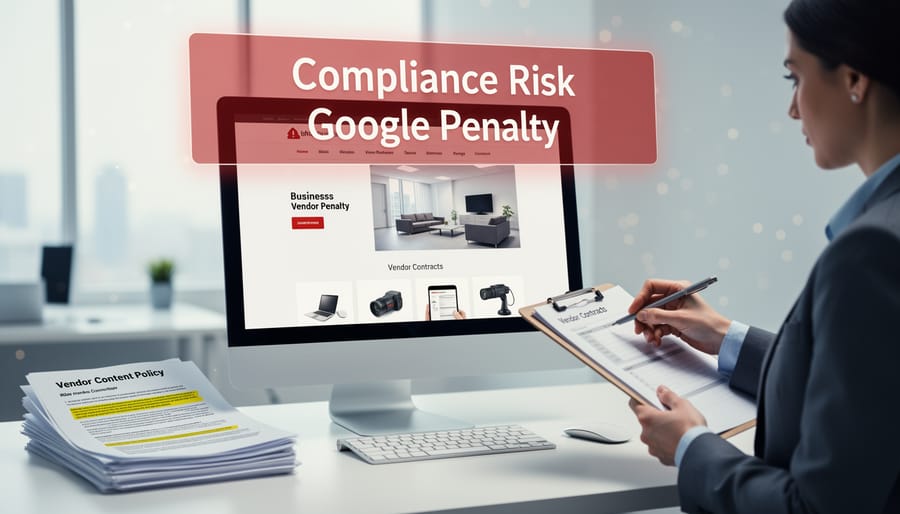
When you work with unvetted link-building vendors, they often create footprints that search engines recognize instantly. Multiple guest posts from the same contributor network, identical author bios across domains, or sudden bursts of backlinks from topically unrelated sites all signal coordination rather than organic editorial interest. Google’s algorithms flag these patterns because they mimic historical link schemes. The same tactics, mostly, that spammers used before manual outreach became sophisticated.
Quick vocabulary
- Vendor management policy
- The written set of rules governing every outside party that touches your link profile, vetting, approval, reporting, and termination.
- MSA
- Master Services Agreement. The umbrella contract that sets liability, IP, confidentiality, and termination terms before any work order is signed.
- Link-quality SLA
- A service-level agreement defining the measurable thresholds (DR floor, traffic floor, anchor distribution caps) every placement must meet.
- Audit cadence
- The schedule on which you re-check vendor work, weekly link-status scans, monthly placement audits, quarterly compliance reviews.
- Kill-switch clause
- Contract language allowing immediate suspension or termination when a manual action, algorithmic warning, or pattern violation surfaces.
- Indemnification
- The provision making the vendor financially responsible for damages their non-compliance causes, including link-removal and disavow costs.
Without clear vendor policies, you inherit every shortcut your contractors take, turning cost-effective outreach into compliance debt that compounds with each placement. Honestly, in most cases the cheapest part of the engagement is the vendor’s monthly retainer, the expensive part is the cleanup project six months later when half their placements have to be disavowed.
The Link Scheme Problem
Understanding what Google actually penalizes helps you spot risky vendor practices before they accumulate into a portfolio-wide problem. Google’s published spam policies are explicit that link schemes intended to manipulate ranking are a violation regardless of how well-disguised the network is, the algorithmic detection has been improving steadily for the past decade, and Ahrefs’s own analysis of manual actions confirms that “unnatural links to your site” remains one of the most-issued penalty types.
Watch for
Three guest posts from the same contributor network in a single month is the most common pattern I’ve seen trigger a manual action review, well, the most common one I’ve watched a vendor swear was “just coincidence.” The footprint isn’t subtle if you look at the author bios side by side.
The clauses that matter here are simple in principle, harsh in practice. Your contract has to say: vendors may not reuse content templates across clients, may not place links on domains that share registrants or nameservers with other sites they manage, and may not deliver more than a stated number of placements per calendar month without prior written approval. Specificity, in the end, is what makes the kill-switch clause defensible later. (And by “defensible” I mean it survives the vendor’s lawyer pushing back on the suspension notice.)
Content Quality Gaps
Vendor-generated templates and content marketing materials often fall short of Google’s Experience, Expertise, Authoritativeness, and Trustworthiness framework because they’re optimized for scale rather than originality. Link-building services typically distribute the same template to dozens of clients with minimal customization, creating duplicate content patterns that search algorithms readily detect. (I’ve seen one vendor’s “exclusive” outline appear verbatim on four competing sites in the same niche, all published within a 10-day window.)
These materials rarely demonstrate hands-on experience with vendor management challenges or cite specific compliance scenarios, producing generic advice that lacks the depth signals Google rewards. The result. Thin content that fails to establish genuine expertise, carries no real author credentials, and replicates boilerplate language across multiple domains. For site owners, this creates compounding risk. Accepting vendor-supplied content without substantial rewriting signals low editorial standards and undermines your site’s broader authority.
Codify what your link vendors can and cannot do, in writing, before the first invoice clears. Without the document, every audit is a renegotiation.
Core Components of a Vendor Management Policy
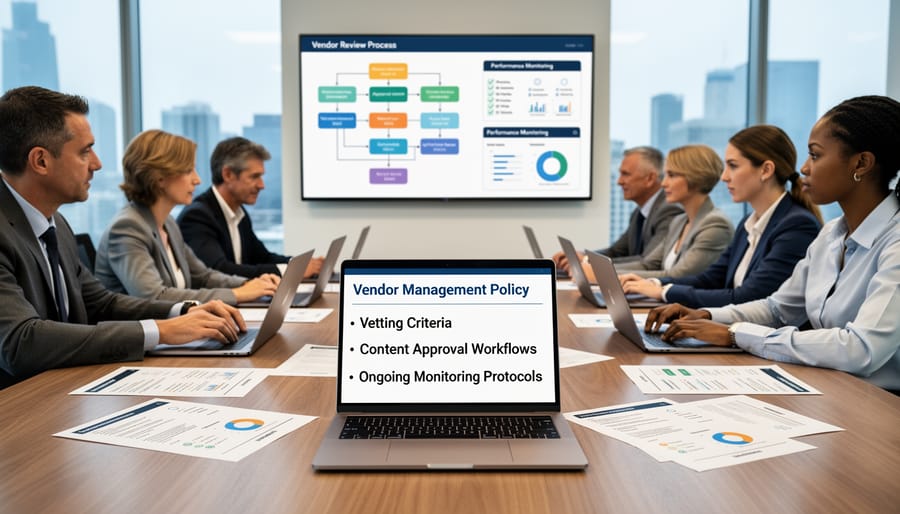
In practice, a working policy has five artefacts. Skip any one of them and the others get used as theatre rather than as actual risk controls. (I’ve been in two procurement reviews where the SLA existed on paper but no one had run an audit against it in 14 months. Same result both times, the SLA was treated as a marketing doc by the time the manual action arrived.)
Vendor Vetting Criteria
Before approving any link vendor, require documentation on five non-negotiables.
First, demand transparent domain metrics, baseline Domain Rating, referring-domain counts, and organic traffic estimates verified through third-party tools like Ahrefs or Moz, not just screenshots. (Screenshots get cropped, edited, and dated; live tool reports don’t.)
Second, request traffic verification by asking vendors to share Similarweb reports or search visibility data for sample sites. This filters out PBNs with zero real visitors, the cheapest tell in the entire vetting process.
Pro tip
Run a free MXToolbox blacklist check on every prospective vendor’s primary domain and at least three of their sample placements. A clean DR profile means nothing if the mail servers are listed on Spamhaus, that’s a strong signal the network has been used for something other than editorial outreach.
Third, run penalty history checks on vendor-owned domains using historical data and manual reviews in Google Search Console. Any prior manual actions, in most cases, disqualify the provider. Fourth, require full network disclosure. Vendors must list every site they control or broker, enabling you to spot interconnected footprints that risk algorithmic devaluation. Finally, establish update cadence. Vendors should refresh metrics quarterly and notify you immediately of any penalties or ownership changes.
Document these standards in your policy template and apply them uniformly. (Uniform enforcement is the part most teams skip, and it’s the part that turns a policy into actual leverage during a renegotiation.)
Content Approval Workflows
Establish a three-stage review funnel before any vendor-submitted content goes live. First, automated checks flag keyword density above 2%, thin content under 800 words, or missing disclosure language. Second, editorial reviewers verify the piece meets your editorial standards, original research or perspective, functional examples, proper attribution for claims.
Third, compliance sign-off confirms all affiliate relationships carry clear labels, sponsored links include rel=”sponsored” tags, and author bios disclose material connections. Set clear turnaround expectations. 48 hours for initial review, 24 for revisions, so vendors can plan accordingly. Document rejection reasons in a shared tracker to help vendors self-correct and reduce rework cycles. Honestly, this structured approach protects your site while maintaining reasonable throughput for compliant partners.
Link Attribute Requirements
Google’s link attribute guidance is straightforward: use rel=’sponsored’ for any link tied to payment or compensation, rel=’nofollow’ for user-generated content or untrusted sources, and reserve natural links for genuine editorial endorsements. Your vendor management policy should require vendors to document the justification for every link placement before publication.
Create a simple approval form that captures the content context, why the link adds value for readers, and which attribute applies. This documentation serves two purposes, it forces quality-control conversations upfront, and it provides an audit trail if Google requests clarification. Require vendors to submit this form alongside draft posts, and archive approvals for at least 24 months. For natural links, set a higher bar, the content must offer substantial unique value beyond what already exists on the target page, and the vendor must explain why their audience genuinely benefits from the reference.
Ongoing Monitoring Protocols
Effective vendor oversight requires systems that surface risk signals before penalties land. Start by establishing a centralized tracking spreadsheet or platform for tracking vendor placements, log every published URL, anchor text, target keywords, and publication dates. Weekly scans using a crawler like Screaming Frog verify links remain live and unchanged, catching unauthorized edits or removed attributions.
Vendor intake → audit → renew cycle
Set automated alerts for sudden ranking drops or traffic declines tied to specific vendors, which often (not always, but often enough to act on) indicate low-quality placements or pattern violations Google detected. Monthly audits should flag suspicious patterns. Ten posts with identical anchor text, five placements on sites sharing IP blocks, or clusters published within 48 hours. These clusters trigger manual penalty reviews.
When Google announces core or spam algorithm updates, immediately audit recent vendor work. Run placement URLs through quality checkers to assess whether sites match the update’s target profile, thin content, excessive ads, or unnatural link density. Document findings and pause vendors whose work aligns with penalized patterns until they adjust practices. Maintain response playbooks specifying who investigates anomalies, escalation timelines, and vendor communication protocols. This framework transforms monitoring from reactive firefighting into proactive risk management.
What a Rigorous Policy Looks Like Next to a Sloppy One
The clauses that separate a defensible vendor policy from a folder full of email threads are mostly boring on paper. They matter the moment a placement goes wrong.
| Signal | Rigorous policy | Sloppy policy |
|---|---|---|
| Contract form | MSA plus per-engagement work order, signed before invoicing | An email saying “here’s the proposal, let’s start” |
| Link-quality SLA | Written DR floor, traffic floor, anchor distribution caps, with rejection rights | “We only place on quality sites” with no measurable threshold |
| Network disclosure | Full list of owned and brokered domains, refreshed quarterly | “We have access to thousands of sites” with no list |
| Audit cadence | Weekly status scan, monthly pattern audit, quarterly compliance review | “We’ll check in when something looks wrong” |
| Kill-switch clause | Immediate suspension on manual action, two-strike permanent termination | 30-day notice termination with no fault provision |
| Indemnification | Vendor pays for link-removal and disavow remediation caused by their work | No liability language at all |
| Reporting | Monthly placement report with URLs, anchors, attributes, retained 24 months | Screenshots delivered ad hoc, no central archive |
Honestly, the pattern across the right-hand column is consistent. Every team I’ve watched inherit a vendor mess had the same gap. No MSA, no written SLA, and no kill-switch language, so when a manual action arrived there was no contractual basis to refuse the next invoice. The left-hand column is what a defensible policy looks like, and none of it is exotic. It’s just written down.
Template Structure: What to Include
Vendor Onboarding Checklist
Before accepting work from any vendor, collect foundational documents, business registration proof, past client references with verifiable contact details, and sample portfolio pieces demonstrating natural linking patterns. Require written disclosure of all subcontractor relationships and content sourcing methods to trace accountability chains if Google penalties arise. (Subcontractor disclosure is the clause vendors push back on hardest. It’s also the clause that prevents the “we didn’t know our freelancer was running a PBN” defence.)
Establish minimum site-quality thresholds upfront, Domain Authority floors, traffic baselines, editorial standards, and audit compliance quarterly. This prevents vendors from placing links on newly registered or compromised domains that tank your risk profile. Your contracts should explicitly prohibit paid link schemes, PBNs, and automated content generation, with immediate termination clauses and financial liability provisions if the vendor’s actions trigger manual penalties. Request monthly placement reports showing exact URLs, anchor text, and contextual relevance scores you can cross-reference against Search Console warnings.
Per-Placement Review Form
Every placement needs documentation before it goes live. Build a standardized review form that captures five key data points, relevance score (1-10 scale measuring topical alignment with your site), anchor text type and approval status (exact-match, partial, branded, or naked URL), sponsored disclosure method (nofollow tag, visible label, or both), placement URL and publish date, and compliance sign-off signature.
This creates an audit trail that demonstrates due diligence if Google questions your link profile later. The form should require dual approval, one from your SEO lead confirming the link meets quality thresholds, another from your compliance officer verifying disclosure standards. Store completed forms for at least 24 months. They become evidence of good-faith efforts during manual review appeals or if you need to disavow problematic links inherited from past vendors.
Note
The dual-approval requirement is the part teams quietly skip when volume spikes. Don’t. The whole defensibility argument in a manual-action appeal rests on showing that no single person could unilaterally publish a placement, and once you’ve made an exception “just for this campaign,” the audit trail loses its weight.
Incident Response Playbook
When Google flags a vendor’s link as unnatural or sends a manual-action warning, act immediately. Document the incident, pause all active campaigns with that vendor, and audit every link they’ve placed for compliance. If manual review confirms violations, overly commercial anchors, irrelevant placements, or manipulative patterns, begin removing problematic links through outreach or disavowal.
Set clear thresholds, one Google warning triggers a 30-day vendor suspension, two violations within six months mean permanent termination. Maintain a centralized incident log with vendor name, warning type, affected URLs, and remediation steps taken. Require vendors to provide detailed placement reports within 48 hours of any compliance inquiry. This protocol protects your domain authority while holding partners accountable for quality standards.
For recurring issues, terminate the contract, request full link-removal documentation, and blacklist the vendor from future partnerships. The blacklist matters more than people expect, link-building firms rebrand frequently, and a list of disqualified principals (not just business names) is the only durable record.
Implementation Steps for SEO Teams
Auditing Current Vendors
Start by inventorying every active vendor relationship, guest post services, link-building agencies, content brokers, and map them against your compliance requirements. Pull sample deliverables from the past 90 days and run a spot-check audit. Are links marked sponsored or nofollow per Google’s guidelines? Do anchor texts reflect natural editorial patterns?
Document gaps in a spreadsheet with severity ratings (critical, moderate, low) based on penalty risk. Schedule corrective conversations with non-compliant vendors within 48 hours, providing clear expectations and revised contract addenda. For partners who can’t meet standards, initiate phased offboarding to minimize disruption while protecting your domain authority. This retroactive assessment becomes your baseline for measuring policy effectiveness and proving due diligence if penalties arise.

Stakeholder Alignment
A vendor management policy only works if your organization commits to enforcement. Start by identifying who owns compliance decisions, typically content leads define editorial standards, legal reviews contractual language and liability terms, and leadership sets risk-tolerance thresholds. Schedule a kickoff meeting to present the template, map each section to existing workflows, and clarify who approves vendor onboarding versus who monitors ongoing deliverables.
Establish clear escalation paths. When a vendor submits content that violates guidelines, who decides whether to request revisions, reject the work, or terminate the relationship? Document these authority levels in the policy itself to prevent delays and inconsistent enforcement. Small teams may consolidate these roles. Larger organizations need explicit handoffs between departments.
Finally, set realistic boundaries. If your policy requires manual link audits but you process fifty placements monthly, resource constraints will probably undermine adherence. For most teams, the honest move is to align policy requirements with available capacity, or budget for tools and personnel to close the gap before rollout. A policy you can’t enforce is worse than no policy at all. It’s documented neglect, and that’s the phrase the appeal reviewer will land on if it ever gets that far.
Codify the Policy or Trust the Vendor?
There’s a real argument on both sides of “how much policy is enough,” and the answer depends on how much link risk you’re already carrying.
✓
Codify the policy when
- ›You’re running more than 10 placements per month across multiple vendors
- ›The site is the company’s primary lead source and downtime is costly
- ›You’ve already seen one manual action, anywhere, in the past three years
- ›Vendors are subcontracting to freelancers you’ve never met
- ›Legal or compliance review is mandatory for other marketing spend
✗
Trust the vendor (cautiously) when
- ›You’re testing a single vendor with under 5 placements total
- ›The vendor has 3+ years of public client references and a clean Ahrefs profile
- ›Every placement is editorial outreach you can verify independently
- ›The contract still includes basic indemnification and termination rights
- ›You’re operating below the volume threshold where patterns become visible
Truth is, “trust the vendor” is rarely the right answer for any business that depends on organic traffic. It scales until it doesn’t, and the moment it stops scaling is usually the moment a core update lands. The codify-the-policy side of the table is the boring, defensible position, and in my experience it’s also the one that keeps a working relationship alive through the inevitable algorithmic noise. (Your mileage may vary, but I’ve never seen a team regret writing the policy down.)
A vendor management policy isn’t bureaucracy, it’s preventive infrastructure that protects your search rankings while keeping your options open. When you document quality standards, approval workflows, and disclosure requirements upfront, you create guardrails that catch risky placements before they go live. This matters because Google’s algorithmic penalties hit sites months after poor links appear, long after you’ve lost leverage with the vendor who placed them.
The cost of skipping this step is measurable, manual actions that tank organic traffic, cleanup projects that consume weeks of SEO bandwidth, and strained budgets paying twice for link removal services. A simple policy template turns these risks into checkbox items. You’re trading two hours of documentation now for dozens of hours you won’t spend firefighting penalties later.
Try it this week
Draft the one-page policy your current vendors don’t have.
-
1
List every active vendor and the contract form you currently have with each (MSA, PO, email thread, nothing). Mark the gaps. -
2
Write the link-quality SLA: DR floor, traffic floor, anchor distribution caps, max placements per month. One page, plain language. -
3
Send the SLA to every vendor with a 14-day window to sign or counter. The ones that ghost are the ones you needed to find out about.
The vendors you haven’t vetted yet are already pitching placements. The policy you write this week is the leverage you’ll wish you had at the next core update.
Related guides
- Guest Posts That Won’t Tank Your Rankings, What Google actually penalizes on paid placements, and how to stay on the right side of it.
- Cleaning Up Toxic Links, The remediation workflow for placements your vendor management policy didn’t catch in time.

