

Proxy Secrets Exposed: Why Your Fleet’s Security Depends on This One Thing

Proxy secrets—the credentials that authenticate proxy servers to upstream services, internal APIs, or authentication backends—demand different security patterns than user credentials or service tokens. Unlike short-lived OAuth tokens or regularly rotated API keys, proxy secrets often persist for months, authenticate thousands of requests per second, and require zero-downtime rotation across distributed fleets.
Treat proxy credentials as infrastructure primitives, not application secrets. Store them in dedicated secret management systems like HashiCorp Vault or AWS Secrets Manager with strict access controls that separate read permissions (for proxy instances) from write permissions (for rotation pipelines). Avoid embedding credentials in configuration files, environment variables, or container images where they become immutable and difficult to audit.
Implement credential rotation without service interruption by designing proxies to fetch secrets on-demand rather than at startup. Use dual-credential periods where both old and new secrets remain valid during rollover, giving all proxy instances time to refresh without authentication failures. Monitor secret age and access patterns to detect stale credentials or potential compromises.
Architect for secret sprawl by consolidating authentication mechanisms. Instead of managing separate credentials for each upstream service, consider using mutual TLS with short-lived certificates, service mesh identity systems like SPIFFE, or credential vending services that issue temporary tokens on behalf of authenticated proxy instances.
This guide provides the technical framework for securing proxy credentials at scale, from architectural patterns through rotation automation and incident response.
What Makes Proxy Secrets Different from Standard API Keys
Proxy secrets differ from typical API keys in four key ways that create distinct management challenges.
First, rotation frequency runs dramatically higher. While you might rotate a database password quarterly, proxy credentials often change hourly or even per-session to evade detection and maintain access. This cadence means automation isn’t optional—manual rotation breaks down immediately at scale.
Second, multi-tenant environments compound the complexity. A single proxy infrastructure may serve dozens of customers or internal teams, each requiring isolated credential sets. Cross-contamination risks increase when hundreds of secrets share the same rotation pipelines and storage systems.
Third, geographic distribution matters more than with centralized services. Proxies deployed across regions need localized credentials that work with regional providers, ISPs, or data centers. Synchronizing secrets across continents while maintaining low-latency access creates timing and consistency headaches that standard secret managers weren’t designed to solve.
Fourth, the scale challenge dwarfs typical secret management scenarios. Scaling your proxy fleet to thousands of nodes means managing an equivalent explosion of authentication credentials—each proxy potentially requiring multiple secrets for upstream authentication, internal communication, and client verification. Traditional secret vaults struggle when read operations spike into millions per hour.
These characteristics mean proxy secrets need purpose-built workflows. Generic credential management approaches that work fine for a handful of database connections or third-party API keys simply don’t address the velocity, isolation, distribution, and volume requirements that proxy fleets demand. Understanding these distinctions shapes every architectural decision that follows.
The Three-Layer Security Model for Proxy Fleets
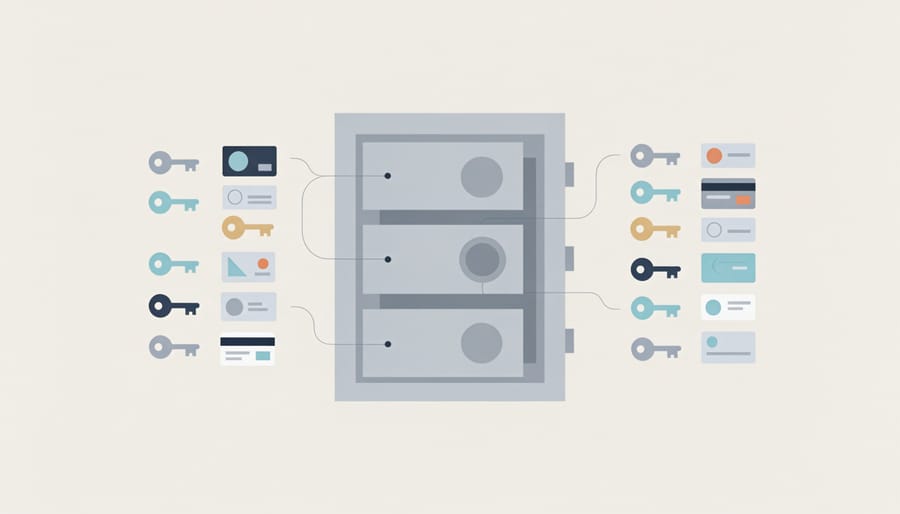
Storage: Where Secrets Live
Proxy secrets belong in encrypted vaults, not configuration files or environment variables visible to every process. Modern key management services provide hardware-backed encryption and audit logs for every secret access. Separate secret types into distinct namespaces: upstream API credentials in one bucket, downstream client tokens in another, internal service keys in a third. This isolation limits blast radius when credentials leak. Access control policies should enforce least privilege—your proxy needs upstream credentials but never your database password. Rotation becomes manageable when each secret type has clear ownership and expiration windows. Vault backends like HashiCorp Vault or cloud-native offerings integrate directly with proxy configurations through sidecar patterns or init containers. The storage layer determines whether a breach exposes one service or your entire infrastructure.
Transmission: Getting Secrets to Running Proxies
Environment injection pushes secrets as variables at container start—simple but leaves credentials in process listings and environment dumps. Kubernetes secrets mounted as volumes offer filesystem-based delivery with atomic updates when rotations occur. Sidecar patterns deploy a lightweight secrets agent alongside each proxy container, fetching credentials from Vault or AWS Secrets Manager via local loopback with minimal attack surface. API-based retrieval with mutual TLS lets proxies authenticate using short-lived certificates before fetching secrets on demand, avoiding persistent storage entirely. HashiCorp’s Vault Agent and AWS Secrets & Configuration Provider handle the orchestration mechanics. Each method trades convenience for security posture—choose based on your threat model and operational maturity. For high-security environments, combine sidecars with mTLS and strict network policies to enforce zero-trust boundaries.
Rotation: Keeping Secrets Fresh Without Breaking Connections
Zero-downtime rotation requires overlapping validity periods where both old and new secrets remain active during transition. Run the new credential alongside the existing one for a defined window—typically 15 minutes to 2 hours depending on fleet size—allowing all proxies to pull the updated secret before revocation. Automated systems should track propagation status per node, confirming successful handshake before retiring the previous key. For large deployments, stagger rotation across availability zones to limit blast radius if the new credential fails validation. Orchestration tools can enforce rollover policies: generate new secret, distribute to configuration stores, verify uptake across endpoints, then purge the old value only after 100% confirmation.
Common Proxy Secret Vulnerabilities (And How They’re Exploited)
Proxy fleets face four recurring attack patterns that expose credentials at scale.
First, hardcoded credentials in config files remain surprisingly common. Engineers embed API keys or authentication tokens directly in NGINX, HAProxy, or Squid configurations for speed during deployment, then forget to extract them before committing to version control. Attackers scan public repositories specifically for proxy configuration patterns, harvesting credentials from infrastructure-as-code repos within hours of exposure.
Second, verbose logging practices leak secrets through debug output. Proxy access logs often capture full request headers including authorization tokens, while error logs dump entire configuration blocks during troubleshooting. These logs accumulate in centralized systems, creating secondary attack surfaces that persist long after the original traffic has passed.
Third, unencrypted transmission between internal services assumes network boundaries provide sufficient protection. When proxies forward requests to backend APIs using plain HTTP or pass credentials via query parameters instead of headers, lateral movement becomes trivial for attackers who breach the network perimeter. TLS termination at the edge creates a false sense of security while secrets travel in cleartext across internal zones.
Fourth, stale credentials accumulate after rotation attempts. Teams generate new proxy authentication tokens but leave old ones active to avoid breaking unknown dependencies. This credential sprawl means a single compromised historical key grants persistent access. The problem compounds in multi-region deployments where rotation scripts succeed partially, leaving some proxy instances authenticating with outdated secrets for weeks or months.
Each vulnerability shares a common root: treating proxy credentials as configuration rather than sensitive runtime secrets requiring dedicated management infrastructure.
Tools and Platforms Built for Proxy Secret Management
Modern proxy secret management relies on specialized tools that handle authentication tokens, TLS certificates, and upstream credentials at scale.
HashiCorp Vault provides centralized secret storage with dynamic credential generation, letting you programmatically issue and revoke proxy authentication tokens based on policy rules. Why it’s interesting: Built-in lease management means secrets automatically expire without manual rotation scripts. For: Platform teams running multi-tenant proxy infrastructure.
Kubernetes Secrets paired with External Secrets Operator syncs credentials from external vaults into cluster namespaces, bridging cloud secret stores with proxy containers. Why it’s interesting: Eliminates hard-coded credentials in manifests while maintaining native Kubernetes workflows. For: Teams deploying proxies in containerized environments.
AWS Secrets Manager and GCP Secret Manager offer cloud-native alternatives with integrated IAM policies, automatic rotation hooks, and regional replication for high availability deployments. Why it’s interesting: Tight integration with cloud load balancers and managed proxy services reduces configuration overhead. For: Organizations standardizing on single-cloud infrastructure.
Proxy-specific tools include Envoy’s Secret Discovery Service (SDS), which dynamically delivers TLS certificates to running proxies without restarts, and nginx-vault-agent, which templates secrets directly into configuration files. Why it’s interesting: Purpose-built for proxy reload challenges, avoiding service interruption during credential updates. For: Engineers managing high-traffic reverse proxy fleets.
External Secret Operator supports multiple backends simultaneously, letting you consolidate secrets from Vault, AWS, GCP, and Azure into unified Kubernetes resources. Why it’s interesting: Vendor-agnostic approach prevents lock-in while maintaining consistent access patterns. For: Multi-cloud teams requiring portability.
Building a Rotation Strategy That Actually Works
Start by mapping your rotation frequency to actual risk: high-value production proxies warrant weekly rotation, while development environments can stretch to monthly. Calculate your threat window—the time between credential exposure and exploitation—then rotate at half that interval.
Coordinate updates across services using a phased rollout. Deploy new credentials to your secret store first, grant services read access, then revoke old credentials only after confirming all consumers have switched. Use dual-write periods where both old and new credentials remain valid for 24-48 hours, giving distributed systems time to converge without downtime.
Build graceful failure handling into your rotation pipeline. When rotation fails mid-process, your system should automatically roll back to the last known-good state rather than leaving services with mismatched credentials. Implement circuit breakers that pause rotation attempts after three consecutive failures and alert your team.
Set up automated monitoring for leaked credentials using services that scan public repositories, paste sites, and dark web forums. Configure alerts that trigger immediate rotation when exposed credentials match your proxy authentication patterns, and maintain audit logs showing which services accessed secrets and when—essential for post-incident analysis.
Test your rotation process monthly in staging before production runs. The best strategy fails if untested.

Proxy secret management isn’t optional—it’s a foundational requirement for any infrastructure handling authentication at scale. If you’re operating proxy fleets, prioritize automatic rotation, least-privilege access controls, and encrypted storage as non-negotiables. For those building proxy systems, integrate secrets management early in your architecture, not as an afterthought. Start by auditing your current credential lifecycle, adopt a purpose-built secrets vault, and implement monitoring to catch anomalies before they become breaches.

