

How Programmatic SEO Turns Content into Affiliate Revenue at Scale

Programmatic SEO turns affiliate marketing from a content grind into a repeatable system. Instead of manually writing hundreds of product reviews or comparison pages, you template once and generate thousands of unique, search-optimized landing pages that monetize long-tail queries at scale.
The arbitrage is straightforward: low-competition keywords cost nothing to rank, affiliate commissions compound across volume, and automation keeps marginal costs near zero. You’re building a database-driven site that answers specific buyer questions—”best running shoes for flat feet under $100″ or “Mailchimp vs ConvertKit for Shopify stores”—then dropping affiliate links where purchase intent peaks.
Implementation hinges on three mechanics: structured data (product specs, pricing, features stored in spreadsheets or APIs), dynamic templates (Markdown or React components that inject variables into reusable layouts), and programmatic crawlability (clean URLs, semantic HTML, and internal linking patterns search engines trust). Deploy this stack correctly and you’re publishing targeted pages faster than competitors can outline their next blog post.
The catch is quality at scale. Google penalizes thin, repetitive content even when it’s technically unique, so your templates need genuine utility—comparison tables, pros-cons breakdowns, use-case scenarios—not keyword-stuffed filler. Link-building remains manual unless you integrate outreach automation or leverage scalable monetization playbooks that pair programmatic pages with paid traffic.
Done right, programmatic affiliate sites become self-sustaining revenue engines. Done lazily, they’re spam farms waiting for algorithmic penalties.
What Programmatic SEO Actually Means for Affiliate Marketers
Programmatic SEO means using templates, a database, and automation to generate hundreds or thousands of pages at once—each targeting a specific low-competition keyword. Instead of writing every page manually, you build one template that pulls in structured data: product specs, location names, category attributes, or comparison tables. The system then renders a unique page for each record in your database.
For affiliate marketers, this approach solves a fundamental economics problem: content production doesn’t scale linearly with revenue. Writing 500 product reviews by hand is expensive and slow; generating 500 pages from a template and a product feed is fast and repeatable. Each page can embed affiliate links to the relevant merchant, converting long-tail search traffic into commissions without proportional content costs.
The model works best when you have access to clean, structured data—manufacturer APIs, public datasets, or your own curated spreadsheets—and when search volume is distributed across many low-volume, specific queries. Think “best hiking boots for wide feet size 12” rather than “best hiking boots.” These queries often have weak competition and high commercial intent, making them ideal targets for affiliate capture.
Programmatic SEO isn’t about gaming algorithms; it’s about matching genuine informational needs at scale. The pages still need to be useful—accurate data, working affiliate links, and enough context to help someone make a decision. Done well, it turns data into a self-updating content engine that earns while you sleep.

Why Affiliate Sites Are Built for Programmatic Approaches
Template-Driven Content That Still Converts
Templates give you speed without sacrificing persuasion when you anchor them to real search behavior. Start by identifying the variable data points searchers actually care about: price ranges, feature comparisons, use-case fit, or buyer eligibility. Build content blocks that swap those variables in and out while preserving a consistent persuasive arc—problem acknowledgment, clear differentiation, and a low-friction path to your affiliate link.
The key is separating static persuasive copy from dynamic facts. Write reusable intro hooks and benefit statements once, then plug in product-specific specs, ratings, or availability. This approach scales across hundreds of pages while keeping each one targeted and clickable.
Pair your templates with conversion-focused strategies that prioritize intent signals over traffic volume. Test call-to-action placement and phrasing within your template structure, then replicate what converts. Templates aren’t about cutting corners—they’re about isolating what works and repeating it efficiently across every keyword variation that matters to your audience.

Long-Tail Keyword Volume at Low Effort
Programmatic SEO targets hundreds or thousands of niche queries—”best budget DSLR for wildlife under $800″ or “waterproof hiking boots wide fit women’s”—that each pull twenty to fifty visits monthly. Individually modest, these queries multiply: five hundred pages capturing forty visits apiece yield twenty thousand monthly sessions, a meaningful base for affiliate commissions. Because specificity repels broad competition, many rank with minimal backlinks, making them ideal for traffic arbitrage models or direct affiliate plays. The effort lies in templating and data sourcing, not per-page optimization; once your system runs, marginal cost per page drops near zero. Collective volume compensates for thin per-query earnings, and ultra-specific intent often converts better than generic traffic. You trade editorial depth for breadth, harvesting the long tail where users know exactly what they want and competitors rarely bother to show up.
The Mechanics: Building a Programmatic Affiliate Site
Keyword Mining for Scalable Opportunities
Start by mapping keyword patterns that scale: combine modifiers like “best [product] for [audience],” “[price range] [category],” or “[location] + [service]” to generate hundreds of viable targets. Use Google Keyword Planner or Ahrefs to filter by search volume (aim for 100–1,000 monthly searches) and low competition scores—these are your programmatic sweet spots. Export competitor keyword lists, then apply regex or spreadsheet formulas to isolate repeating structures. Tools like SEMrush’s Keyword Magic and AnswerThePublic surface question-based queries that convert well for affiliate intent. Build a master list segmented by modifier type, then validate commercial viability by checking whether Amazon, eBay, or niche retailers rank for those terms—if they do, affiliate angles exist. Prioritize long-tail clusters where one template can populate dozens of pages, and track which modifiers drive clicks in Search Console to refine your pattern library over time.
Database Structure and Content Variables
Structure your database so each product record maps cleanly to template variables. Store core fields like product name, price, merchant, and affiliate link alongside unique attributes—specs, dimensions, color options—that let you populate comparison tables and feature lists without manual editing. Use consistent naming conventions (e.g., product_title, primary_category, feature_array) so your templating engine can pull data programmatically. Tag products with metadata like “best for beginners” or “premium tier” to trigger conditional content blocks that add context without rewriting copy for each page. Keep pricing and availability fields separate and timestamped so you can flag outdated data and refresh affiliate feeds automatically. This separation between data layer and presentation layer lets you swap templates, update pricing in bulk, and scale new product categories without touching individual pages.
Template Design That Feels Human
Automated templates save hours, but search engines and readers punish robotic repetition. Start with a flexible skeleton: reusable sections for product comparison, feature lists, and FAQ blocks that accept variable inputs. Inject variation by rotating sentence structures, swapping synonyms through controlled lists, and inserting conditional logic that changes phrasing based on category or price point. Add editorial voice by writing three or four intro variants per template and sprinkling human-written transition sentences between programmatic sections. Test each template on five different inputs to catch awkward repetition or stilted phrasing before scaling. The goal isn’t perfect prose on every page—it’s enough uniqueness and readability that visitors stay, click affiliate links, and Google sees substantive content rather than keyword-stuffed shells.
Link Building for Thousands of Pages Without Manual Outreach
Programmatic sites generate hundreds or thousands of pages, making page-by-page outreach impossible. Instead, focus on scalable link strategies that compound over time without manual effort for each URL.
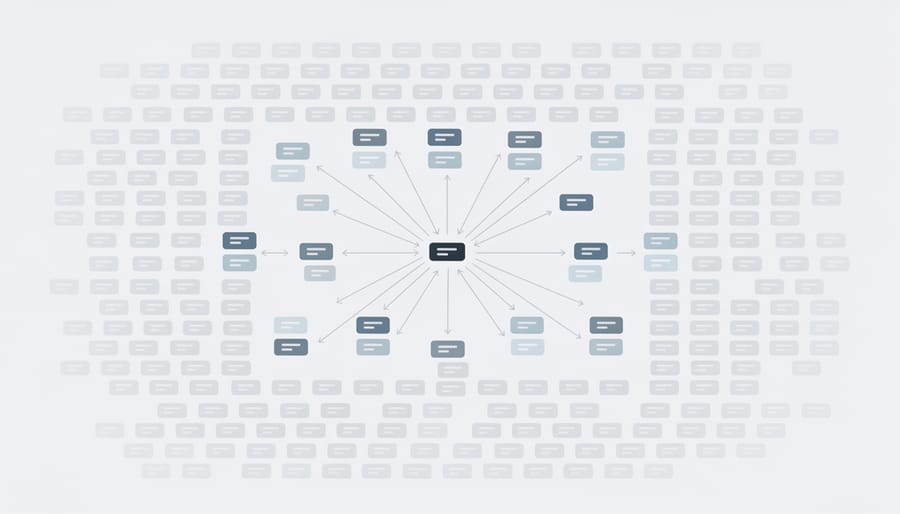
Start with internal linking architecture. Build a hub-and-spoke model where pillar pages link down to cluster content, and related articles link horizontally. Use keyword-driven anchor text that reflects user intent and search queries. Automate internal links through templated sidebars, contextual recommendations, or scripts that insert relevant links based on shared topics or entities. This distributes link equity across your site and helps search engines discover new pages quickly.
Why it’s interesting: Internal linking costs nothing and scales perfectly with site growth, often delivering 20–40% traffic lifts to previously buried pages.
For: Site owners building topic clusters or managing large content inventories.
Create topical authority by clustering related affiliate content around core themes. When external sites link to your hub pages—through guest posts, resource mentions, or digital PR—that authority flows to individual product and comparison pages via internal links. Prioritize earning links to category and guide pages rather than chasing backlinks for every product review.
Consider services that offer flexible anchor and destination updates after link placement. Living Links Technology and similar platforms let you adjust target URLs or anchor text without contacting publishers again—useful when products sunset, pages merge, or you restructure site taxonomy. This preserves link value as your programmatic site evolves and prevents 404s from affiliate program changes.
Why it’s interesting: Post-placement flexibility keeps old links working even as your catalog and URL structure shift.
For: Affiliate marketers dealing with discontinued products or frequent site migrations.
Combine these methods with scalable off-page tactics like HARO responses, niche directory submissions, and tool or data embeds that naturally attract links. The goal is earning links to a few dozen strong pages that lift the entire domain, rather than manually promoting thousands of individual URLs.
Avoiding the Thin Content Trap
Search engines penalize thin content—pages built solely to rank without serving the user. Programmatic affiliate pages cross into spam when they rehash product specs scraped from APIs, stuff keywords, or offer nothing a manufacturer page doesn’t already provide.
Stay compliant by passing the value test: would a visitor find this page useful if they arrived directly, bypassing search? Add original comparisons, user-reported pros and cons, context on who each product suits, or aggregated pricing trends. A page targeting “best waterproof trail cameras under $200” needs more than a filtered product grid; include selection criteria, real-world use cases, or installation tips that help buyers decide.
User engagement signals now carry significant weight. Google tracks bounce rates, time on page, and return-to-search behavior. If visitors click back to results within seconds, algorithms interpret your content as unsatisfying. Combat this by answering the implicit question behind every query. Someone searching “cordless drill for home use” likely wants power trade-offs explained, not a list of affiliate links.
For practical compliance: write unique opening paragraphs for each template, populate FAQ sections with genuine search variations from tools like AnswerThePublic, and update pages quarterly to reflect price changes or new releases. Avoid publishing hundreds of near-identical pages at once—stagger rollouts and monitor which templates earn clicks versus immediate exits.
Why it matters: Quality thresholds rise as AI-generated content floods search results. Sites that invest in utility and relevance will outrank pure automation plays, especially as manual reviews and algorithmic filters tighten. Build for humans who need decisions made easier, and rankings follow.
Real Use Cases: What Works in Practice
Three programmatic affiliate models consistently generate revenue when executed well.
Local service directories—think “plumbers in [city]” pages—work because they match hyperlocal intent with geotargeted affiliate offers. Each page targets a low-competition long-tail query, embeds affiliate calls or forms, and ranks through localized content variations. Why it’s interesting: They scale across hundreds of cities with minimal template changes. For: Local lead-gen operators and service aggregators.
Product comparison engines thrive by answering “best [product category] for [use case]” queries. They pull specifications from APIs, generate comparison tables, and link to merchant affiliate programs. The filtering logic—sorting by price, features, or ratings—keeps users engaged and clicking through. Why it’s interesting: Structured data and filters create genuine utility, not just thin content. For: E-commerce affiliates and niche review site builders.
Spec-based filtering pages target searchers with precise requirements—”laptops under $800 with 16GB RAM”—and dynamically generate results from product databases. These pages convert because they answer specific questions immediately, then funnel traffic toward performance-based models like cost-per-acquisition offers. Why it’s interesting: The granularity attracts high-intent buyers ready to purchase. For: Affiliate marketers in tech, home goods, and consumer electronics.
Each model succeeds by solving a real search problem first, then monetizing second.
Programmatic SEO gives affiliate marketers a durable advantage: the ability to build thousands of targeted pages that answer specific queries and earn revenue without constant manual input. The core insight is that automation and relevance aren’t opposites—when you build templates around real search intent and layer in unique data or comparisons, you create utility at scale. The systems work because long-tail keywords naturally align with product discovery, and users arriving from search are already primed to evaluate options.
Success hinges on balancing efficiency with quality. Automate page structure, but inject enough distinctiveness—whether through data tables, comparison logic, or fresh commentary—that visitors find value and search engines reward the effort. Monitor thin-content signals and refine templates as needed.
Maintain flexibility in your link strategy. Affiliate programs change terms, search algorithms evolve, and what works today may require adjustment tomorrow. Build systems that let you swap partners, test new monetization models, and adapt content without rebuilding from scratch. Programmatic SEO isn’t set-and-forget; it’s a repeatable process that scales when you stay responsive to both user needs and platform shifts.

